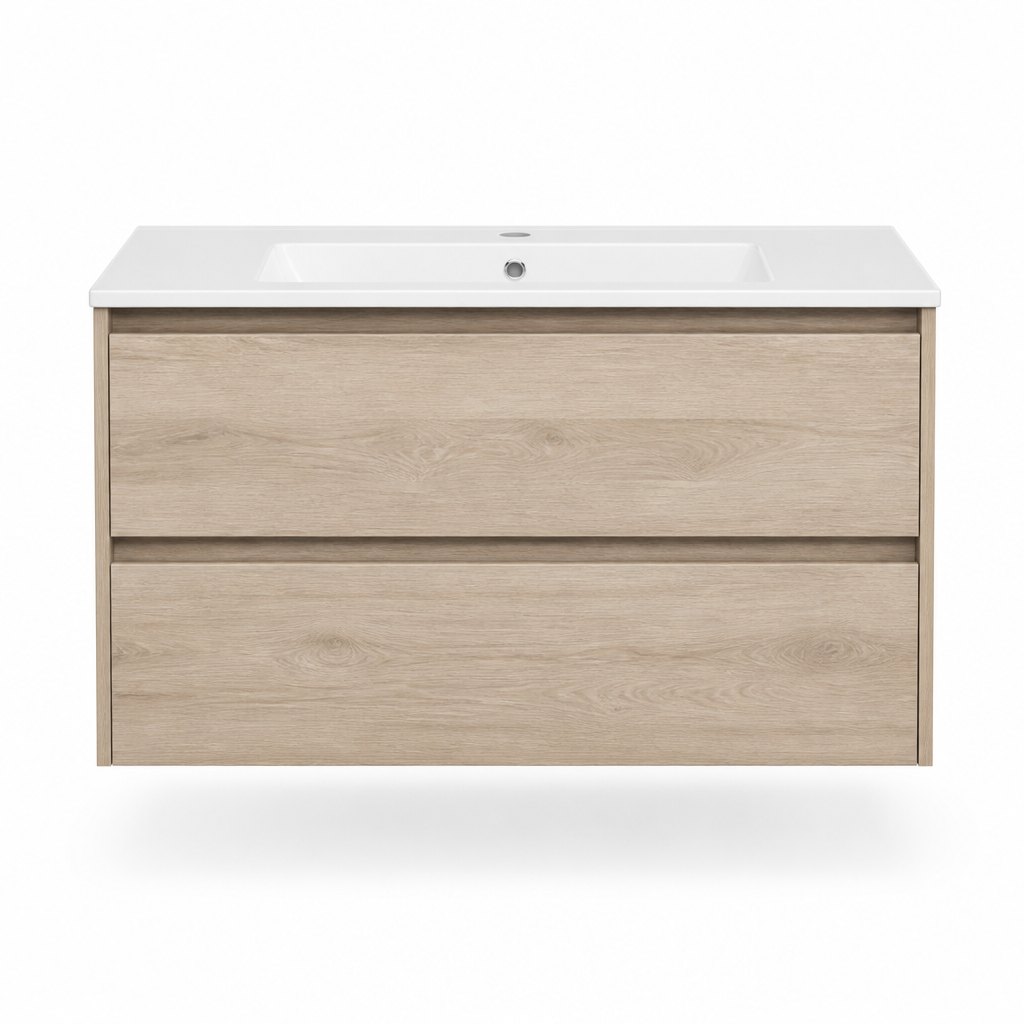
900mm Hamptons Shaker Wall-Hung Vanity — Chalk White, Sintered Stone, Brushed Nickel — FAME bathroom cabinet manufacturer
New 2026 · AU Programme · Hamptons Shaker · Sintered Stone

900mm Hamptons Shaker Wall-Hung Vanity — Chalk White, Sintered Stone, Brushed Nickel

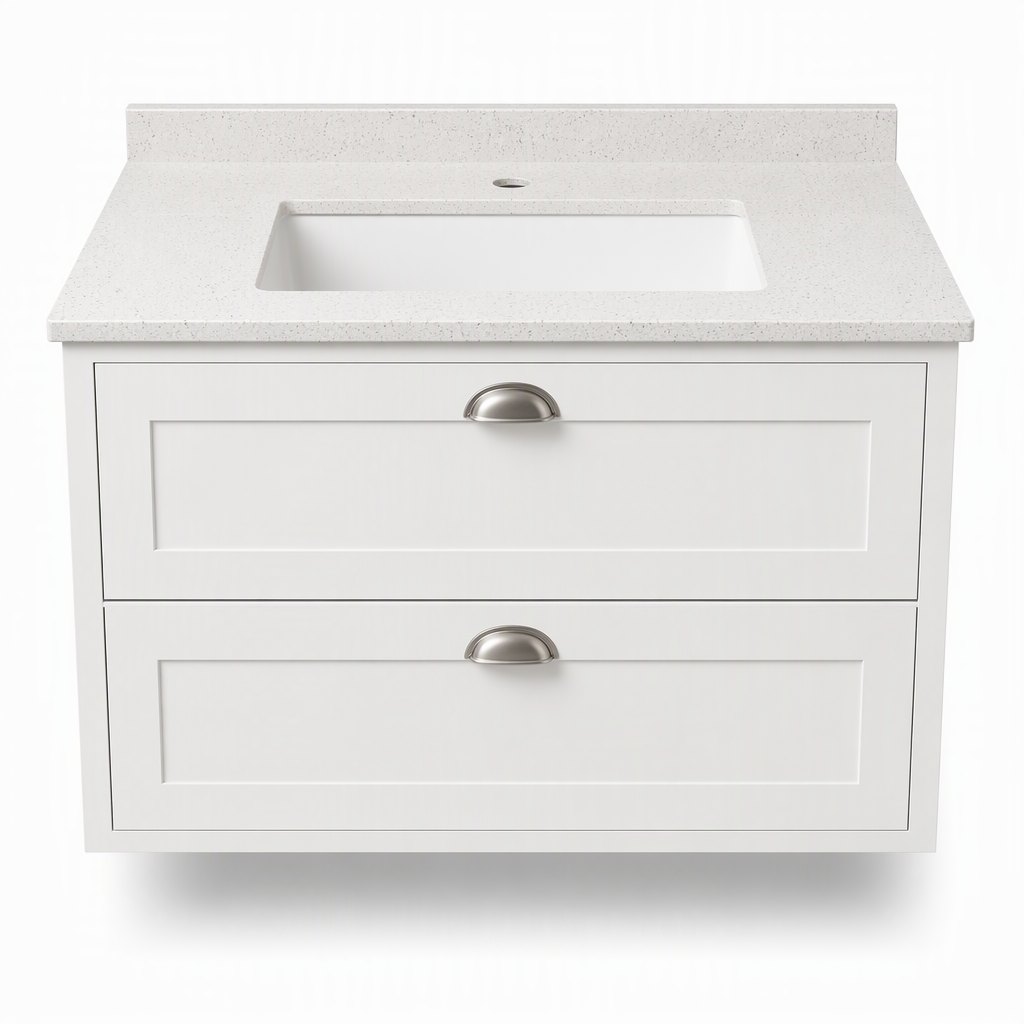
In Australia the 900mm vanity is not a compromise size, it is the default: it is the widest cabinet that still fits a 1500mm bathroom wall alongside a shower screen, and the narrowest that gives two full drawers and a basin without the user's elbows hitting the mirror. What has changed in 2026 is the front. Handleless slabs have had four strong years, and the pendulum has swung back toward a framed door — specifically the Hamptons shaker profile that Australian renovators keep specifying because it reads as furniture rather than as a kitchen cabinet that wandered into a bathroom. At the same time the counter has moved to sintered stone, because a pressed and fired slab takes a bonded basin aperture without a visible silicone seam. This page puts those two together on a 900mm wall-hung carcass: 460mm deep, 520mm high, an 18mm moisture-resistant carcass, two full-extension soft-close drawers, 70mm shaker frames in chalk white super-matt lacquer, a 20mm warm-white sintered stone top with a bonded integrated basin, and slim brushed nickel bow cup pulls. Nothing on it is decorative for its own sake — the frame adds 9mm of shadow line that hides a splash, and the stone removes the joint that goes dark first.

  • 900 x 460 x 520mm wall-hung cabinet — 460mm is the working depth in Australian bathrooms because it clears a 500mm floor waste set-out and still leaves a 900mm clear circulation zone in front of the basin, and 520mm puts the basin rim at a comfortable height without the 850mm a floor-standing unit forces
  • 18mm moisture-resistant carcass on all six faces with a sealed glue line and ABS-edged panels, not bare chipboard: an Australian bathroom holds high humidity for twenty minutes after every shower, and an MR board keeps its thickness where standard board swells at the bottom edge
  • 70mm shaker frames with a 9mm recessed centre panel and a 2mm eased inner edge, so the profile casts a real shadow line at 300mm viewing distance and the panel does not read as a printed image of a frame
  • Chalk white super-matt lacquer at 5 to 6 gloss units over a matched primer, sprayed rather than foiled, so the frame and the panel are one continuous film and there is no edge band to lift in a wet room
  • 20mm sintered stone top in warm white with a fine grey fleck, 2mm arris edge and a 60mm upstand, cut for basin and tap before crating; the integrated solid-surface basin is bonded and sealed into the aperture, so there is no silicone joint around the rim to discolour
  • Integrated basin roughly 420 x 300 x 130mm internal with a fall to a 40mm waste and an overflow slot machined into the bowl wall rather than clipped on
  • Two full-extension drawers on soft-close runners rated 35kg — 120mm clear at the top for upright bottles, 240mm clear below with a movable divider — and the drawer bank can be handed left or right at order stage
  • Slim brushed nickel bow cup pulls on a 96mm drill pitch, through-bolted from the inside so they cannot spin; matte black and brushed brass are available on identical drilling if the programme runs one cabinet in three finishes
  • Soft-close clip-on hinges and runners as standard, with Blum hinges and Blum TandemBox drawer systems available on identical drilling — the upgrade is a hardware swap, not a second door programme
  • Wall-hung on a galvanised steel rail with 400mm and 600mm fixing centres, tested to 200kg static load, supplied with a written fixing specification for timber frame, plasterboard over studs and masonry, plus a plywood pattress detail where the studs miss the rail
  • Matched 900 x 750mm mirror in a 22mm frame on the same fixing centres, or an IP44-rated backlit mirror with anti-fog pad and touch dimmer; a 300mm side cabinet and a 900mm shaving cabinet both fit the same carcass drilling
  • MOQ 20 pcs per model, with 600, 750, 900 and 1200mm widths mixable inside the 20; factory certifications ISO9001, CE, SGS, IP44 and FSA, 17 years in cabinet manufacturing

SKU: FAME-AU-1111 · MOQ: 20 pcs · Sample order available

Specifications

Sizes and module900 x 460 x 520mm as standard; 600mm, 750mm and 1200mm on the same carcass tooling and the same 460mm depth; the 900mm module takes a 420mm basin with 60mm of stone to each end and leaves 90mm behind the tap for a wall-mounted spout
Construction18mm moisture-resistant board carcass on all six faces, sealed glue line, E1 board with ABS-sealed edges, glued and dowelled corners, 8mm back panel and 32mm system drilling; the front rail is reinforced to carry the stone top and basin without a centre leg
Fronts and finish18mm MR-MDF fronts with a 70mm shaker frame, a 9mm recessed centre panel and a 2mm eased inner edge; chalk white super-matt lacquer at 5 to 6 gloss units over a matched primer, three coats cured in a heated booth, sprayed as one film with no edge band
Top and basin20mm sintered stone in warm white with a fine grey fleck, 2mm arris edge and 60mm upstand; integrated solid-surface basin roughly 420 x 300 x 130mm with a machined overflow slot and a 40mm waste; a ceramic undermount with a stone top is available on the same cut programme
Storage layoutTwo full-extension drawers, 120mm clear at the top and 240mm clear below with a movable divider, soft-close and rated 35kg per pair; a two-door variant with one adjustable shelf on 32mm pitch uses the same carcass and the same pull drilling
HardwareSlim brushed nickel bow cup pull on a 96mm pitch, through-bolted with an internal ferrule; brushed brass and matte black on identical drilling. Soft-close runners and hinges as standard, Blum hinges and Blum TandemBox runners available as an option on the same drilling
InstallationWall-hung on a galvanised steel hanging rail with 400mm and 600mm fixing centres, tested to 200kg static load; a written fixing specification covers timber frame, plasterboard over studs and masonry, plus a plywood pattress detail where a stud falls outside the rail
Plumbing set-outOne 40mm waste aperture and one 15mm supply pair cut to your set-out before crating; a 55mm service void behind the drawer boxes for a bottle trap, with the drawer bank offset at order stage where a trap would foul it; all apertures edge-sealed in the factory
Mirror and shaving cabinetMatched 900 x 750mm mirror in a 22mm frame with 5mm copper-free glass, or an IP44-rated backlit mirror with anti-fog pad and touch dimmer; a 900mm shaving cabinet and a 300mm side cabinet both fit the same carcass drilling and the same rail
Packaging and weightKnock-down in two cartons: carcass and drawer boxes at roughly 28kg in a 5-layer carton with corner protection and foam-separated fronts, and the sintered top and basin crated flat with edge blocks; one marked packing list per set
MOQ and lead time20 pcs per model, with 600, 750, 900 and 1200mm widths and the three hardware finishes mixable inside the 20; 20 to 30 days production after finish and stone approval plus 18 to 26 days sea freight to Sydney, Melbourne or Fremantle
Compliance and Australian notesFactory certifications ISO9001, CE, SGS, IP44 and FSA; E1 low-emission board, low-VOC water-based lacquer, FSC-certified plywood on request. The cabinet itself is furniture — the tapware and waste you pair with it carry their own Australian plumbing certification, and we cut the top to your set-out rather than to a generic template

Verification & Compliance — Evidence Behind Every Claim

Every FAME unit is built and inspected to the same standards we ship to the world's top-10 bathroom brands. Each claim below carries a verifiable anchor — certificates and inspection reports are available for review on request or during factory audits.

ISO9001 Quality management system CE EU conformity marking SGS Third-party inspected IP44 Splash & moisture resistance per IEC 60529 FSA Forest & safety assurance
IP44 moisture protectionRated to IEC 60529 (splash-proof, protection against objects >1mm). Test method and report available on request.
Soft-close hardwareBlum optional — see Blum official specifications.
Company credentialsFounded 2009 · 20,000 m² factory · supplier to global top-10 bathroom brands. See About FAME and Certifications.
Third-party verificationSGS inspection reports and certificate scans available with your quotation — request them here.

In a Real Bathroom

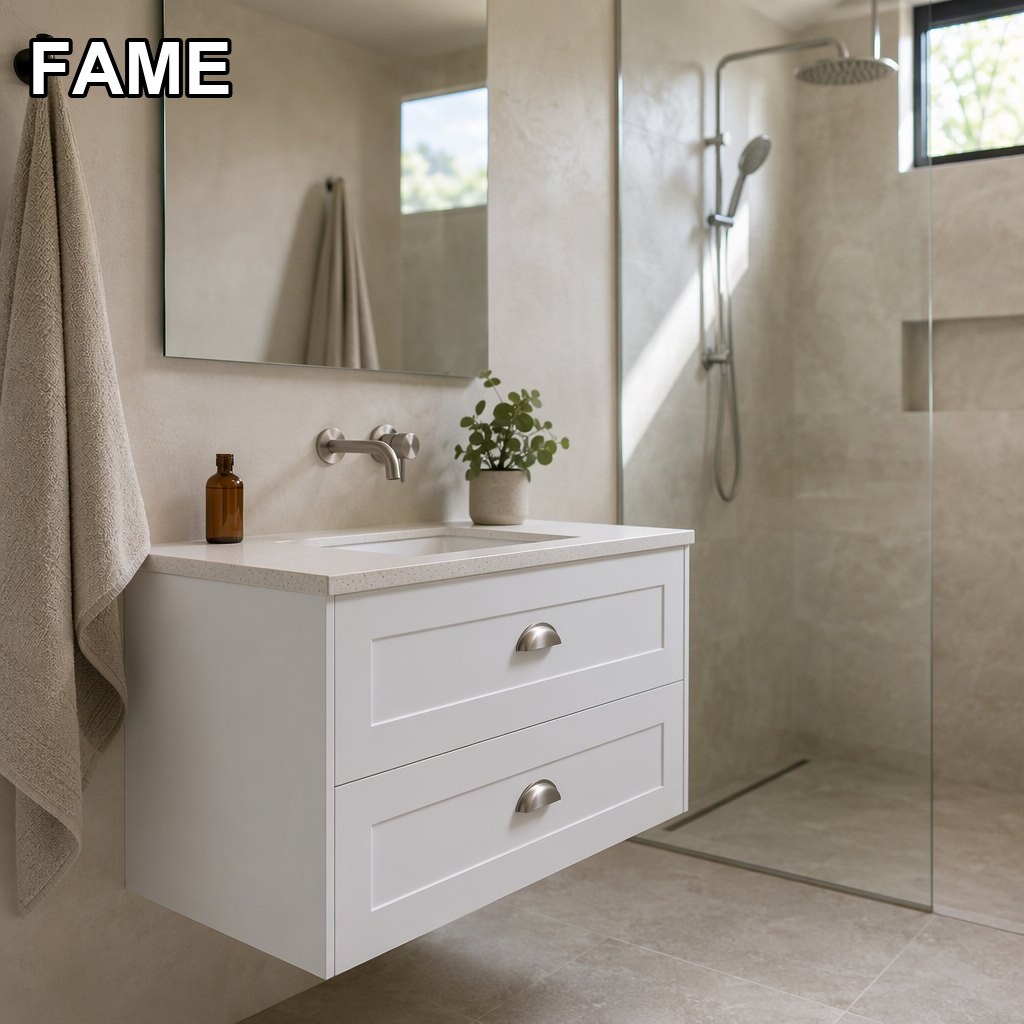
900mm Hamptons Shaker Wall-Hung Vanity — Chalk White, Sintered Stone, Brushed Nickel in a real bathroom setting

Every FAME unit is produced in our 20,000 m² factory, inspected against the same standards we ship to the world's top-10 bathroom brands, and container-optimized for your program.

Product FAQ

Why is a shaker front coming back in Australian bathrooms after years of handleless?
Because the two rooms ask different things of a door. In a kitchen a handleless slab wins on cleanability and on the fact that nobody looks at a cabinet from 400mm away while standing still. In a bathroom you are at arm's length from the front twice a day, and a framed shaker gives that distance something to read: a 70mm frame with a 9mm recess casts a real shadow line, and the panel inside it breaks up the reflection of a downlight. The practical argument is the same one: the recess hides a dried splash and softens the fine scratches that a flat gloss face shows within two years. What we would not claim is that a frame is more waterproof than a slab — both are lacquered MR-MDF here, and both want the same wipe-down.
How does chalk-white matt behave in a wet room?
Better than gloss, with one honest caveat. At 5 to 6 gloss units the surface does not mirror water spots or fingerprints the way a gloss face does, and because the front is sprayed rather than foiled, a scuff inside the frame is a spot repair with a matched pot, not a replacement door. What it will show is a soap splash or a hair-dye mark on a pale face, so a weekly wipe is part of the routine. Where the household is genuinely rough on cabinetry, the sensible structure is chalk white on the wall-hung unit and a darker tone on any tall storage in the same room — we spray both from one batch record so they never drift apart.
Sintered stone or ceramic on top — what actually differs?
The joint around the basin. Sintered stone is a pressed and fired slab with the same density through its thickness, so the bowl aperture is machined and the basin bonded in with a joint that does not read as a seam; a ceramic top cannot take a bonded bowl at all, and an engineered quartz top wants a visible silicone line at that joint. Sintered stone also shrugs off the two things that damage a vanity top in practice — hair dye and descaler — where a resin-bound quartz will etch. The trade-off is cost, which is in the slab and in the tooling, and weight, which is why the unit ships as two cartons with the stone crated flat.
How does a wall-hung cabinet fix to an Australian plasterboard wall?
With a rail, not with four screws into the board. The unit hangs on a galvanised steel rail fixed through the plasterboard into the studs at 400mm or 600mm centres, or into masonry with the supplied anchors, and the cabinet then adjusts 8mm on the rail for a wall that is out of plumb. Where a stud lands in the wrong place we specify a plywood pattress behind the finished wall, and the fixing drawing ships in the carton so the installer knows where the load is going before the first hole is drilled. We test the assembly to 200kg static load, roughly four times a full basin plus a person leaning on it.
How does a 20-piece order work across widths and finishes?
Twenty pieces per model, and the 20 can mix 600, 750, 900 and 1200mm widths, a left or right drawer bank, brushed nickel, brushed brass or matte black hardware, and a sintered or ceramic top, because the carcass drilling, the rail and the stone cut programme are common across the range. What needs its own run is a colour change on the fronts — a custom RAL or a matched paint is 60 pieces per colour with a sprayed sample approved first — or a change of bowl profile. Production runs 20 to 30 days after finish and stone approval, then 18 to 26 days by sea to Sydney, Melbourne or Fremantle. We have been building cabinets since 2009 — 17 years — in a 20,000 m² factory in Jiangshan, Zhejiang, and we supply several of the world's ten largest building-material brands on the same lines.

Quote This Model for Your Program

Tell us quantity, finish and destination port — we'll come back with pricing, lead time and a sample proposal.

Request a Quote