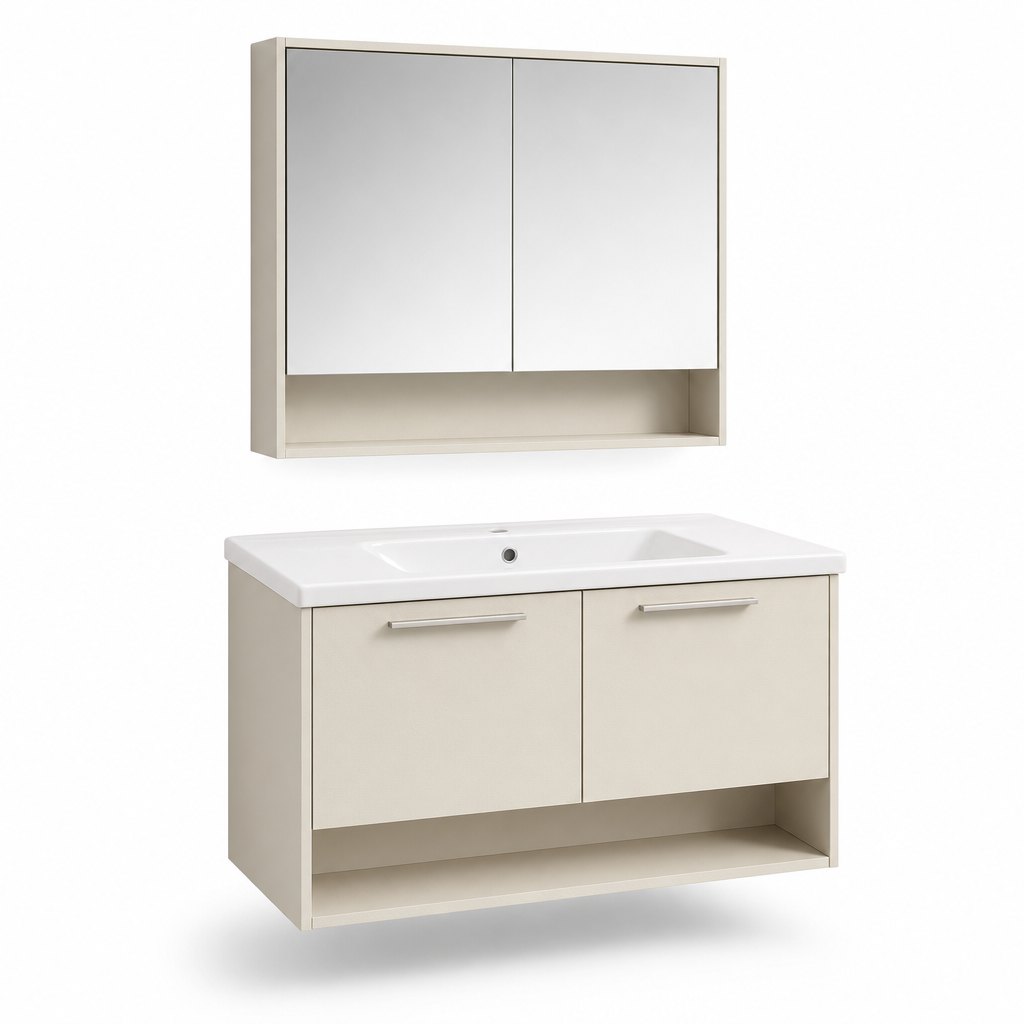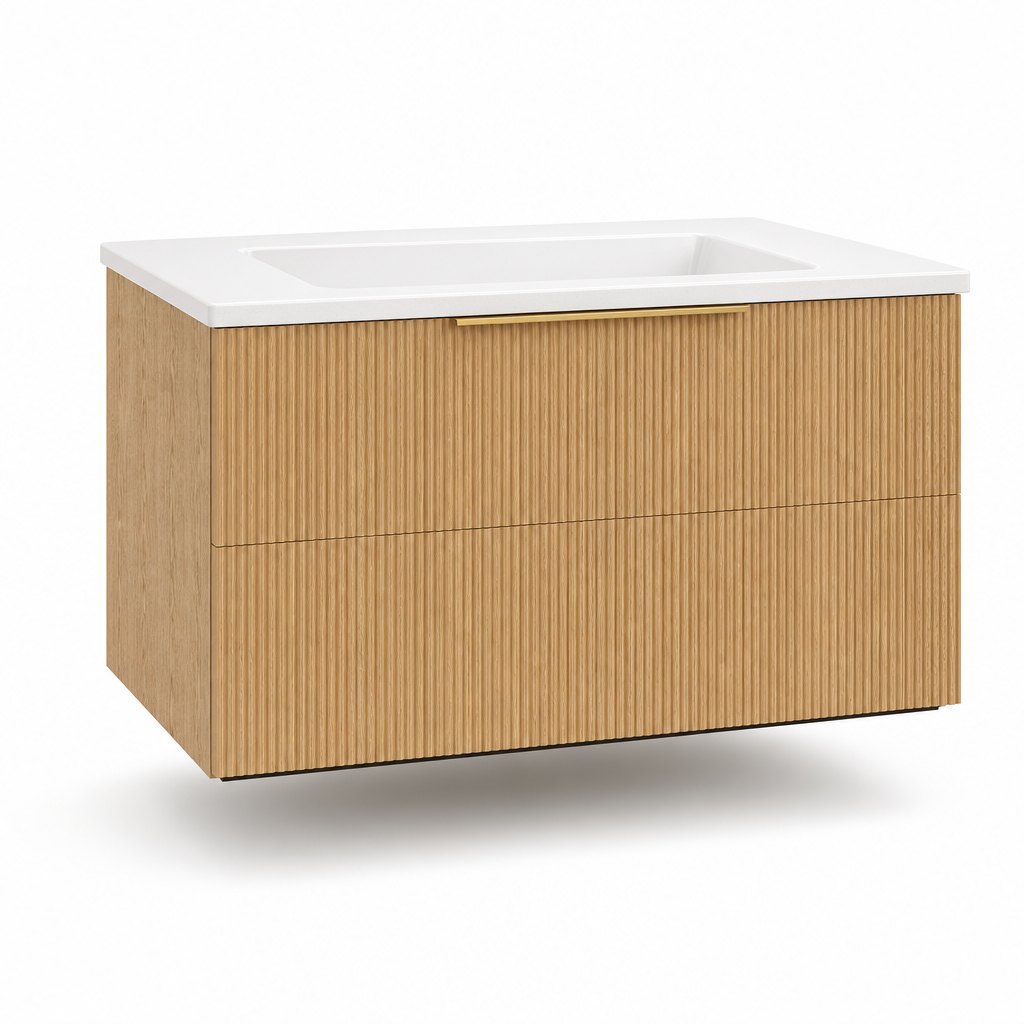
1000 mm Wall-Hung Vanity with a Travertine Slab Carved into the Basin — FAME bathroom cabinet manufacturer
New 2026 · Carved Travertine · Cream Lacquer · French Suspended Series

1000 mm Wall-Hung Vanity with a Travertine Slab Carved into the Basin

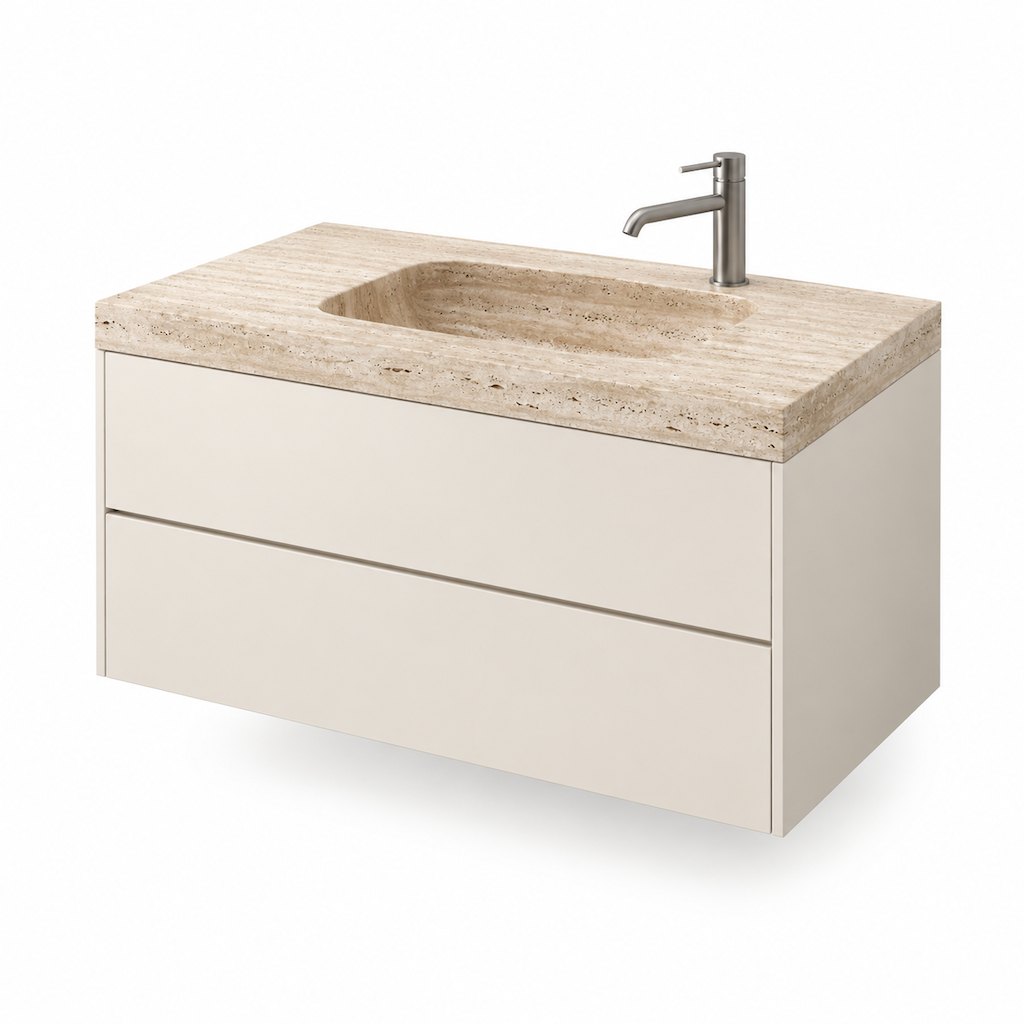
A French bathroom renovation almost never starts with a free wall. It starts with a 4 to 6 m2 room, a cast-iron soil pipe in one corner, a window that has to open, and a door that swings inward — which is why the meuble suspendu replaced the vanity unit on legs in most Parisian apartments, and why the depth, not the width, is usually the constraint. This model takes the 400 mm depth that keeps a 1.2 m clear floor and pairs it with the material that has led French bathroom specification since 2024: travertine. The difference here is that the bowl is not a ceramic insert dropped into a hole. The 30 mm slab is carved so the basin and the top are one piece of stone, with no silicone line at the rim, no 40 mm upstand to trap water, and no separate waste cover to lose. Underneath is a cream matt-lacquer carcass on two full-extension drawers, plywood rather than MDP because a stone top does not forgive a carcass that moves. It is a 20-piece programme built for importers and project specifiers, not a single showroom piece.

  • 1000 mm W x 400 mm D x 480 mm H wall-hung carcass — the 400 mm depth is the figure that matters in a French apartment, because it keeps a 1.2 m clear floor in front of the unit while still taking a 500 mm drawer box; 460 and 520 mm depths on the same fronts
  • 30 mm natural beige travertine slab with the bowl carved directly into the stone — 480 x 340 x 130 mm inner bowl, walls sloped at roughly 12 degrees, hand-finished rim at a 2 mm eased edge, so there is no insert, no rim gasket and no joint line to re-silicone in five years
  • Travertine specified as vein-cut, filled and honed rather than polished — the open pores are filled and the surface is left matt, because a polished travertine in a wet room shows every water spot and reads as a hotel bathroom rather than a French one
  • Two handleless drawers with a 3 mm even shadow-gap reveal and push-to-open runners, or 12 mm slim brushed nickel bar pulls at 320 mm centres on the same drilling pattern if the project wants visible hardware
  • 18 mm waterproof plywood carcass with sealed ABS edges and an 8 mm moisture-resistant back panel — specified because a 45 to 55 kg stone top plus a filled basin will telegraph any carcass deflection straight into the stone joint
  • Integral brushed nickel single-lever mixer in 304 stainless with a PVD nickel finish, 35 mm ceramic cartridge, and a 32 mm slotted waste; the tap hole is drilled back-right by default, with centre, left or undrilled for a wall spout on request
  • Optional 1000 x 700 mm mirror with a 5 mm copper-free silver glass, 4000K edge LED at CRI 90+, IP44 rated, touch dimmer and anti-fog film — quoted as its own SKU so the cabinet can ship with or without it
  • Galvanised steel hanging rail with two M8 through-fixings per stud plus a 25 mm levelling range, supplied with a paper drilling template and a French-language fixing sheet that names BA13, hollow-block and masonry walls separately

SKU: FAME-FR-1024 · MOQ: 20 pcs · Sample order available

Specifications

Programme scopeWall-hung 1000 mm vanity with a carved travertine top; two-drawer carcass in cream matt lacquer; optional 1000 mm mirror with edge LED quoted as a separate SKU. Widths 800 / 1000 / 1200 mm on the same front and runner programme.
Dimensions1000 mm W x 400 mm D x 480 mm H carcass; the 30 mm slab brings the working height to 510 mm above the finished floor; 460 and 520 mm carcass depths available for projects with more floor to give; 800 mm and 1200 mm widths use identical hardware and drilling
Carcass18 mm waterproof plywood with sealed ABS edges and an 8 mm moisture-resistant back panel; 18 mm E1 MDP available as a lower-cost option for dry rooms and inland projects where the wall is masonry and the room is mechanically ventilated
Fronts and finish18 mm MDF drawer fronts in cream-ivory matt lacquer at 3 to 5 gloss units over a two-coat polyurethane system; handleless with a 3 mm reveal as standard, or 12 mm brushed nickel bar pulls; custom RAL from 50 pcs in one colour
Top and basin30 mm vein-cut natural travertine, filled and honed to a matt finish; basin carved into the slab at 480 x 340 x 130 mm with 12 degree sloped walls and a 2 mm eased rim; single slab per unit, no joints, no upstand; 20 mm thickness available where weight is critical
Stone treatmentFactory-applied impregnating sealer (hydrofuge oleofuge) on all faces including the bowl; re-treatment recommended every 18 to 24 months in a family bathroom, and the sealer is supplied in a 250 ml touch-up bottle with each order
HardwareFull-extension soft-close drawer runners rated 35 kg with 3D front adjustment; Blum Tandembox and Blumotion hinge upgrade available on the identical carcass drilling; push-to-open or bar-pull operation, not both
Tap and wasteBrushed nickel 304 stainless single-lever mixer with a 35 mm ceramic cartridge and a 350 mm flexible connection; 32 mm slotted waste with a 1 1/4 in. French-standard trap adapter supplied loose; tap hole back-right as standard, other positions to order
Mirror and lighting option1000 x 700 mm mirror, 5 mm copper-free silver glass, 4000K edge LED at 9 W/m and CRI 90+, IP44, touch dimmer, anti-fog film and a 12V driver with a remote box; 3000K and a shaver socket on request
InstallationWall-hung on a galvanised steel rail with two M8 anchors per stud, a 25 mm levelling range and shim washers; separate fixing kits for BA13 plasterboard on metal stud, hollow block and solid masonry; French-language drilling template included
PackagingTwo cartons per unit — carcass 1060 x 480 x 560 mm at 32 kg gross, stone top 1100 x 480 x 160 mm at 34 kg gross; foam corner blocks, 5-layer board, and the slab in a rigid honeycomb insert with a plywood face board so a 45 kg stone top does not ride on its own edge
MOQ and lead time20 pcs per model, widths and two lacquer colours may be mixed inside the 20; sample 7 to 10 days, production 30 to 35 days, FOB Ningbo or CIF Le Havre, Marseille-Fos or Dunkerque
ComplianceISO9001, CE, SGS and FSA factory certifications; E1 low-emission board with test reports; IP44 on the mirror for bathroom zone 2; load and stability test reports to EN 14749 available on request for project submittals

Verification & Compliance — Evidence Behind Every Claim

Every FAME unit is built and inspected to the same standards we ship to the world's top-10 bathroom brands. Each claim below carries a verifiable anchor — certificates and inspection reports are available for review on request or during factory audits.

ISO9001 Quality management system CE EU conformity marking SGS Third-party inspected IP44 Splash & moisture resistance per IEC 60529 FSA Forest & safety assurance
IP44 moisture protectionRated to IEC 60529 (splash-proof, protection against objects >1mm). Test method and report available on request.
Soft-close hardwareBlum optional — see Blum official specifications.
Company credentialsFounded 2009 · 20,000 m² factory · supplier to global top-10 bathroom brands. See About FAME and Certifications.
Third-party verificationSGS inspection reports and certificate scans available with your quotation — request them here.

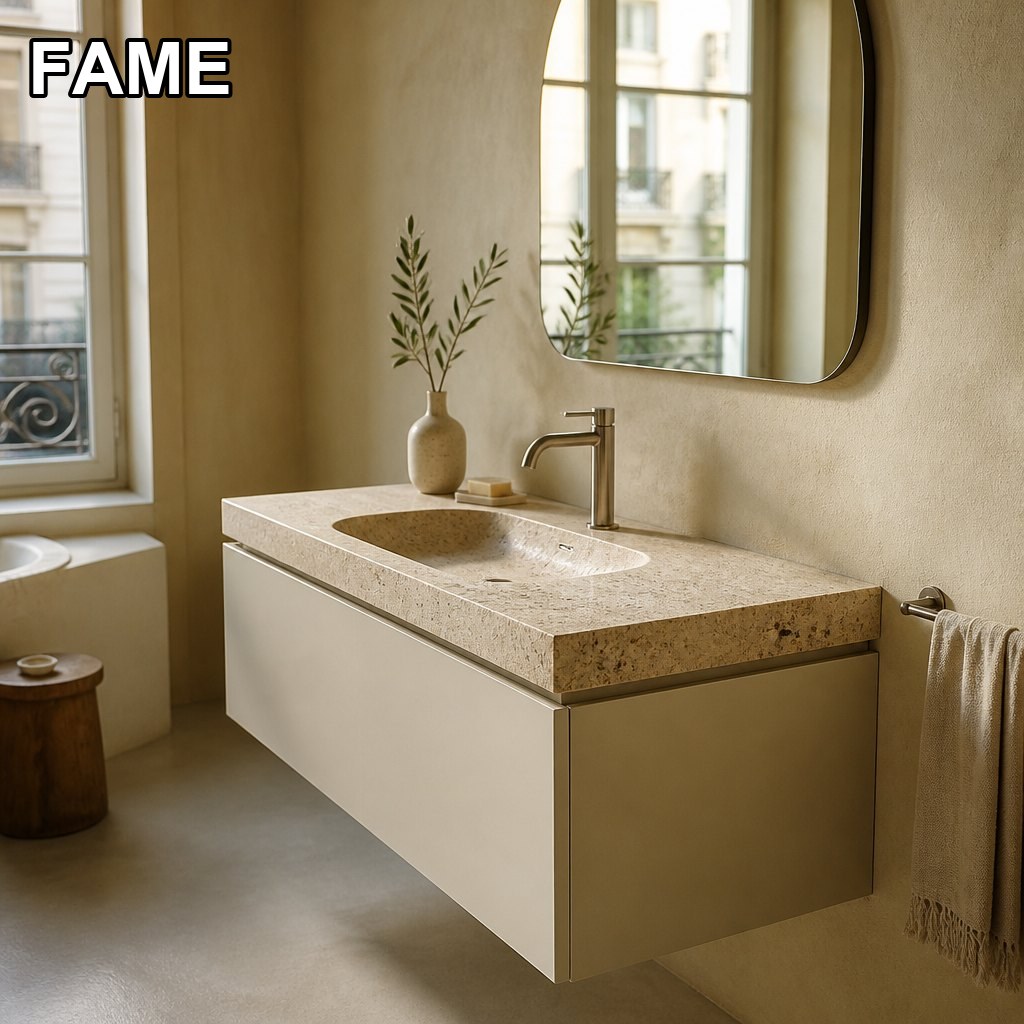
In a Real Bathroom

1000 mm Wall-Hung Vanity with a Travertine Slab Carved into the Basin in a real bathroom setting

Every FAME unit is produced in our 20,000 m² factory, inspected against the same standards we ship to the world's top-10 bathroom brands, and container-optimized for your program.

Product FAQ

Why travertine rather than quartz or a ceramic basin for a French bathroom?
Because the two materials fail in different ways and French buyers have become specific about which failure they will accept. A quartz top with a ceramic insert is the cheapest route and it performs, but the rim joint is a silicone line that discolours first in a room with no window and a towel radiator drying washing. Travertine removes that joint entirely — the bowl is stone because the slab is stone — and it can be re-honed locally with 400 and 800 grit if it dulls, which no glazed ceramic can be. The trade-off is honest: travertine is a limestone, so it is porous, it wants sealing every 18 to 24 months, and it will not survive a tenant leaving bleach in the bowl. In an owner-occupied apartment it ages well; in a rental portfolio, quartz is the safer specification and we quote both on the same carcass.
How much does the stone weigh, and what wall does it need?
The 30 mm slab for a 1000 x 400 mm unit is about 26 kg before the bowl is carved and roughly 22 kg after, and the complete unit lands at 50 to 55 kg loaded with water. That is fine on masonry or on a concrete wall, and it is fine on BA13 plasterboard only if the rail is through-fixed into the studs or into a plywood pattress behind the board — which is why the fixing sheet names the three wall types separately instead of shipping one universal anchor. In a French renovation the wall is often the problem rather than the cabinet: a 1970s plasterboard partition over brick will hold a 20 kg ceramic unit happily and will not hold this one without a pattress. We supply the rail, the anchors and a 25 mm levelling range; the pattress is site work.
Does the carved bowl stain, and how is it maintained?
It is sealed in the factory and it will still mark if it is left wet with hard water or if soap sits in it. The maintenance routine is the same one used on travertine floors: wipe dry after use, avoid acidic and abrasive cleaners entirely, and re-apply the impregnating sealer every 18 to 24 months — the sealer is included with the order. What the sealer does not stop is mechanical damage, and the bowl is the part that takes it. A dropped bottle will chip the rim; that chip can be filled with a colour-matched stone repair compound and re-honed, and we supply the matching filler with the unit. Deep staining from a metal can or a hair dye is the one failure that is not recoverable in situ, which is why we recommend the honed finish: a honed surface can be re-sanded, a polished one shows every scratch.
Why 1000 mm and 400 mm deep, rather than the 800 mm unit sold in French DIY stores?
Because 800 mm is what fits a new-build specification and 1000 mm is what fits a renovation. In a Haussmann-era bathroom the wall between the door reveal and the soil pipe box is commonly 1.05 to 1.2 m, and an 800 mm unit leaves a 250 mm gap that ends up holding a laundry basket or a bin. The 1000 mm unit uses the wall properly and still leaves the 600 mm the door needs to swing. The 400 mm depth is the other half of the same argument: at 460 mm the room stops being walkable in front of the bath. For a 1.2 m wall the 1000 mm is the largest that clears the reveal; where the wall is only 900 mm, the same programme runs at 800 mm with no change to the drawer boxes or the stone, only to the slab length.
What does a 20-piece order look like, and how does it ship to France?
Twenty pieces can be split across 800, 1000 and 1200 mm widths and across two lacquer colours, with a custom RAL starting at 50 pcs in one colour; the mirror is a separate SKU and can be dropped entirely. Each unit ships as two cartons because the stone must not ride on the carcass, so a mixed 20-piece order lands at roughly 3.4 cbm — around a fifth of a 20 ft container, which is why most French importers consolidate this with a mirror programme or a second bathroom line rather than shipping it alone. Sample lead time is 7 to 10 days, production 30 to 35 days, FOB Ningbo or CIF to Le Havre, Marseille-Fos or Dunkerque, with the stone declared separately on the packing list so the customs entry is clean.

Quote This Model for Your Program

Tell us quantity, finish and destination port — we'll come back with pricing, lead time and a sample proposal.

Request a Quote