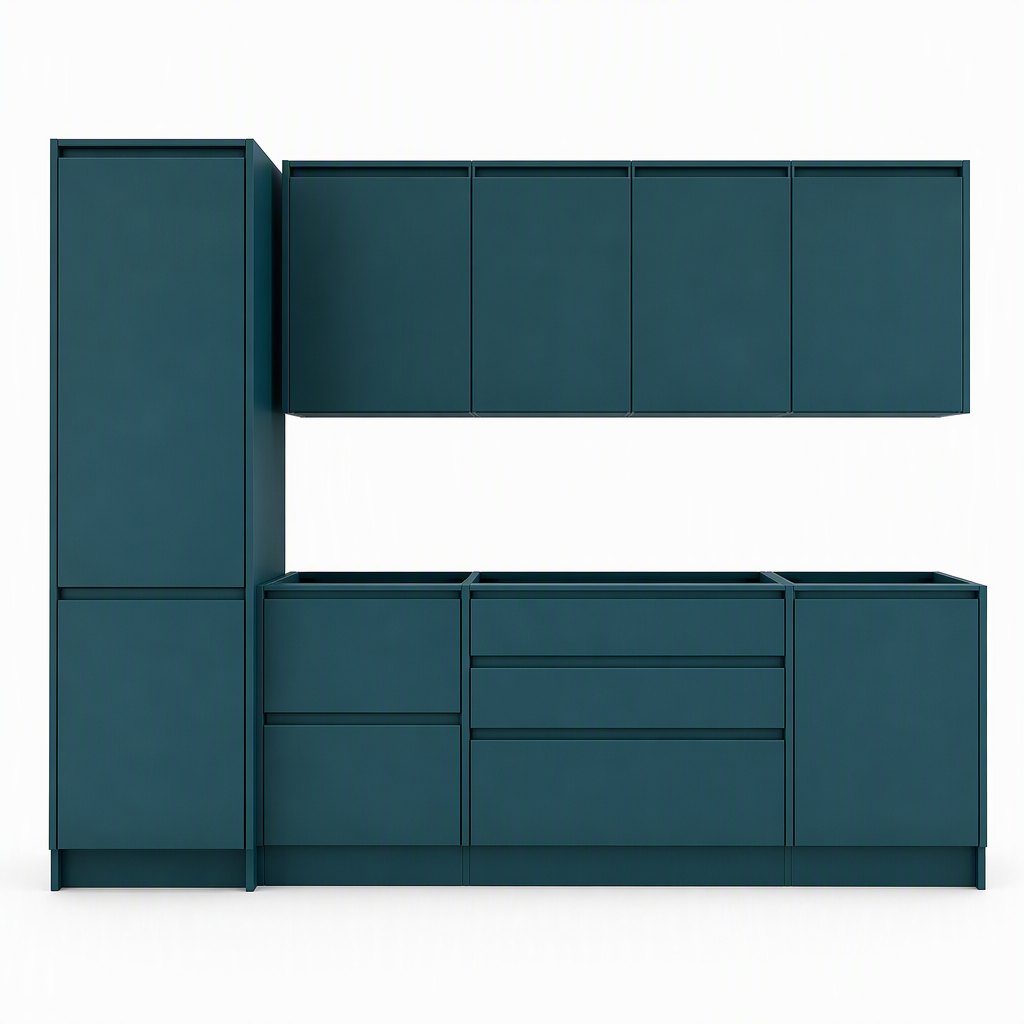
Aubergine Matt Lacquer Kitchen — A Plum That Reads Brown by Daylight — FAME kitchen cabinet manufacturer
New 2026 · Finish Cycle II · Aubergine · Handleless Slab

Aubergine Matt Lacquer Kitchen — A Plum That Reads Brown by Daylight

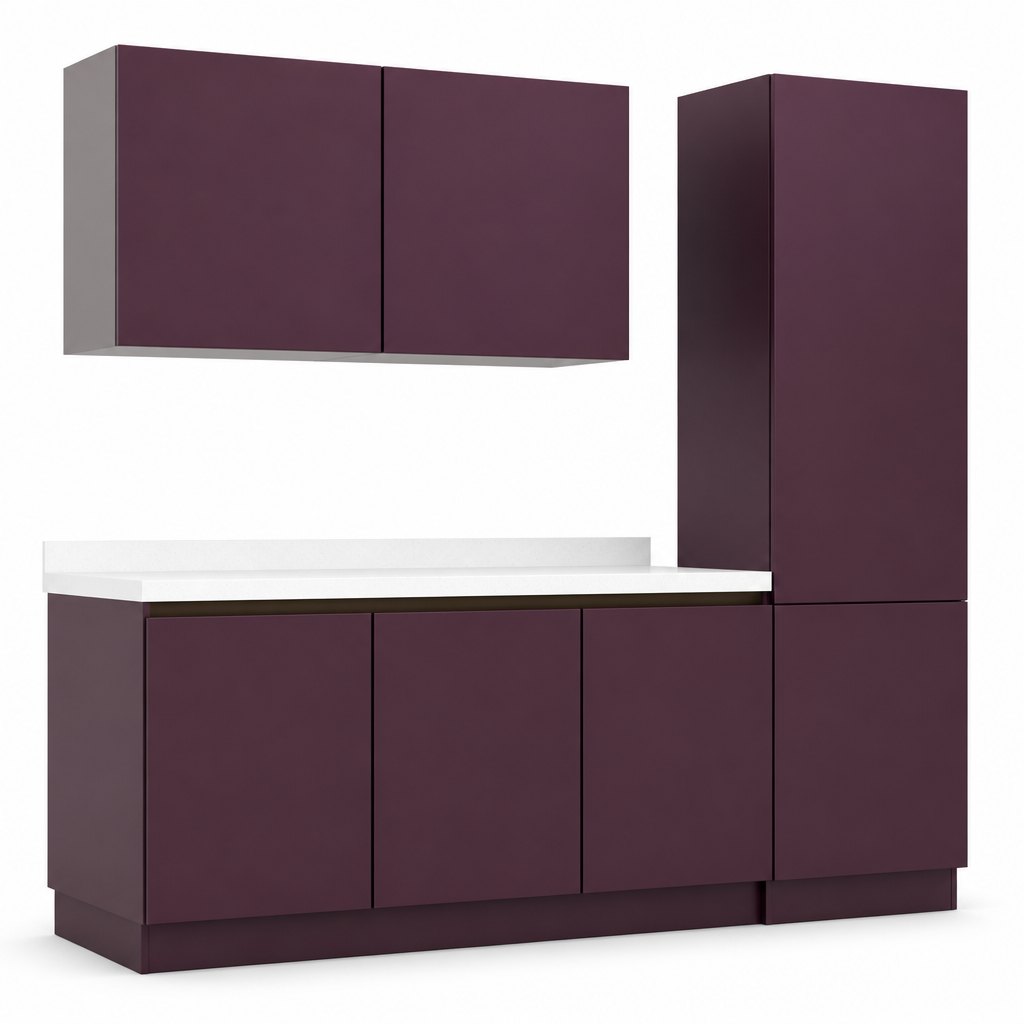
Aubergine is the most misjudged colour in a kitchen showroom, and the reason is almost always the light it was sampled under. A plum pigment carries red and blue in roughly equal measure, so under a warm 2700K showroom spot it leans brown and reads easy, and under a north-facing window at 10am it turns violet and the customer asks what happened. Both readings are correct; what decides whether the kitchen works is the amount of black in the mix and the sheen on top of it. This programme is a deep aubergine with the black pulled back and the red held, sprayed at 4 to 6 gloss units so no specular highlight lifts the purple, on 19mm handleless slabs with a 3mm shadow gap and a dark bronze J-profile. Underneath it is the standard FAME carcass — 18mm E1 board, 32mm system drilling, soft-close throughout, widths from 300 to 1000mm on a 50mm grid. A second-cycle colour for importers and kitchen studios that already carry navy, forest green and charcoal and need a dark that is warmer than all three.

  • Deep aubergine super-matt lacquer at 4 to 6 gloss units measured at 60 degrees — black reduced and red held in the pigment so the colour stays a warm plum in daylight instead of collapsing into purple under a cool north light
  • 19mm flat slab doors and drawer fronts, sprayed and cured in a heated booth rather than foiled, so the face is one continuous film with no edge band and no seam line under raking light
  • Handleless as standard: a consistent 3mm shadow gap between fronts with a recessed aluminium J-profile in dark bronze under the worktop and above the base run, or push-to-open with no profile on the upper run
  • 18mm E1 board carcass with sealed edges, glued and dowelled corners, 8mm back panel and 32mm system drilling on every side panel — the same carcass as our foil, veneer and shaker programmes, so a mixed kitchen quotes as one order
  • Modular widths from 300 to 1000mm on a 50mm grid across base, wall, tall and drawer units, with end panels, plinth and filler panels sprayed in the same aubergine batch
  • Base units 720mm high and 560mm deep, wall units 720mm high and 350mm deep, tall units 2010 to 2280mm, on a 100mm recessed plinth set back 60mm so the run reads as a floating mass rather than a box on the floor
  • 20mm white quartz worktop with a 20mm upstand, cut for sink, hob and tap to your set-out before crating; a pale grey-veined quartz is the recommended pair because a warm beige top turns an aubergine front muddy at 400mm
  • Soft-close clip-on hinges with three-way adjustment and soft-close full-extension runners as standard, with Blum hinges and Blum TandemBox runners available as an option on identical drilling
  • Sprayed rather than foiled fronts, which is what allows a touch-up: the batch code is recorded on the packing list and a 250ml matched lacquer pot ships with every 20-piece run
  • Anti-fingerprint behaviour comes from the matte film itself, not an additive: at 4 to 6 gloss units a handling mark on a deep colour is visible, so the specification includes a matched-panel care card in the carton rather than a promise that the surface will not mark
  • Height-adjustable wall-unit hangers and cover caps sprayed in the same aubergine, so no white plastic plug shows on a dark front after installation
  • MOQ 20 pcs per model, produced in our 20,000 m² factory, ISO9001, CE and SGS certified, 17 years in cabinet manufacturing

SKU: FAME-KC-AUBG · MOQ: 20 pcs · Sample order available

Specifications

Programme scopeBase, wall, tall and drawer units as one coordinated finish programme; end panels, plinth, filler panels and cover caps sprayed in the same aubergine batch and recorded under one batch code
Construction18mm E1 board carcass, sealed edges, glued and dowelled corners, 8mm back panel and 32mm system drilling on every side panel; adjustable shelves on 32mm pitch; wall units on height-adjustable hangers
Doors and fronts19mm flat slab door and drawer front, 22mm on tall and appliance-tower fronts for rigidity; sprayed and cured in a heated booth, one continuous film with no edge band; 3mm shadow-gap reveal on every joint, no frames and no visible hinges when closed
Surface and finishDeep aubergine super-matt lacquer, 4 to 6 gloss units at 60 degrees, two coats over a white primer so the red in the pigment stays true; smooth film with no printed grain, so there is no repeat pattern across a 6m run
Colour matchingAubergine is held as a spray reference and matched to a supplied panel or a RAL / NCS reference before the run; a 200 x 300mm sprayed approval panel is issued for sign-off, and a 250ml matched touch-up pot ships with every 20-piece order
Modular widths300 to 1000mm on a 50mm grid; standard heights 720mm base, 720 to 900mm wall, 2010 to 2280mm tall; 560mm base depth and 350mm wall depth as standard, 600mm deep base available for appliance housings
Worktop and splashback20mm white quartz with a 20mm upstand and a matching splashback panel; a pale grey-veined quartz is recommended over a warm beige stone; sink, hob and tap apertures machined to your set-out before crating; a 38mm laminated top is available for entry price points
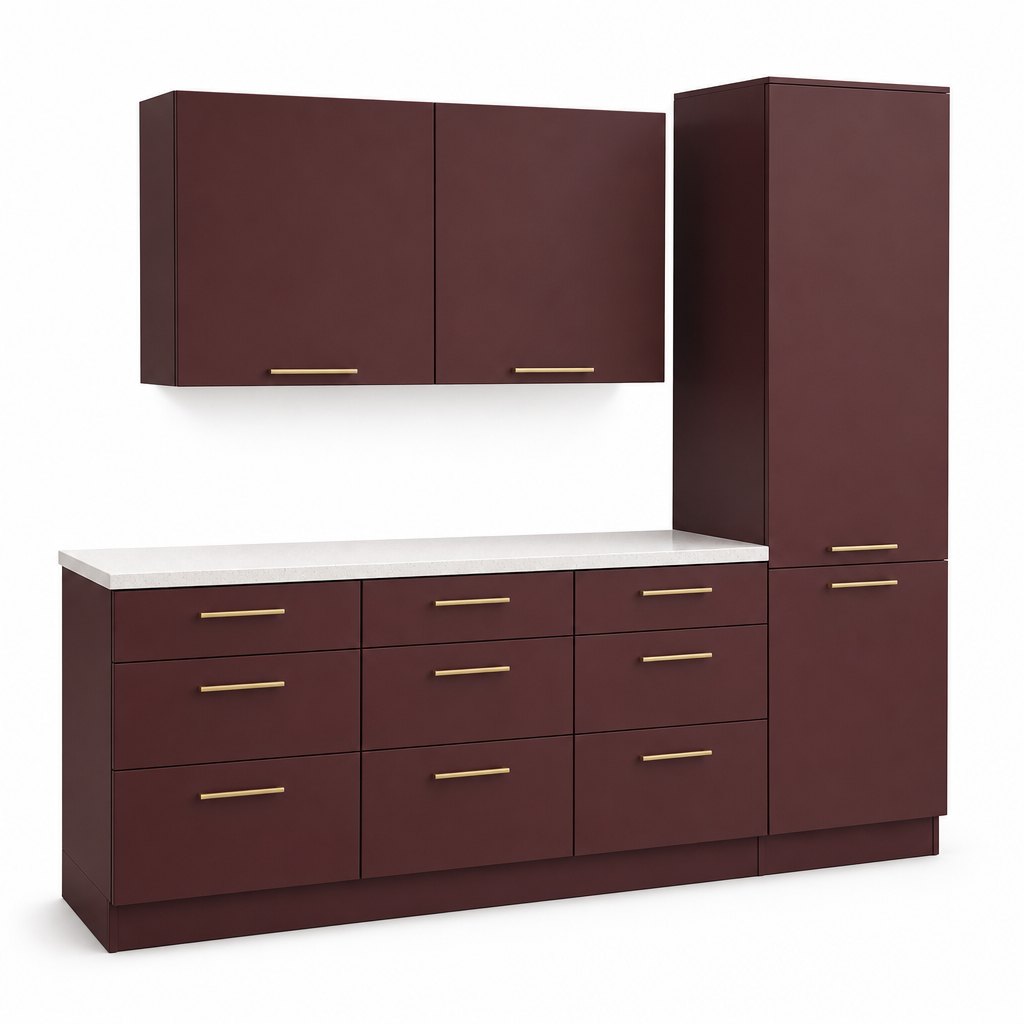
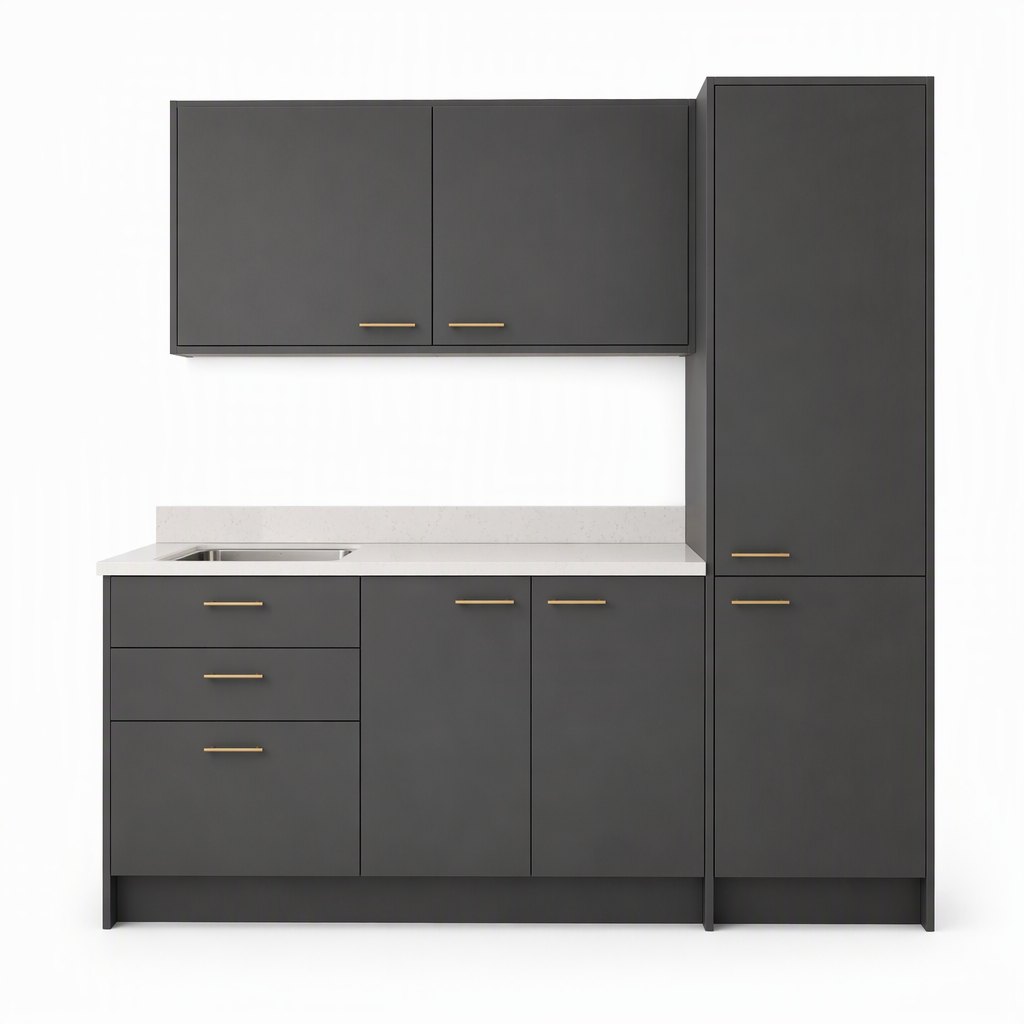
Operation and handlesHandleless as standard on 3mm shadow gaps with a recessed aluminium J-profile in dark bronze, or push-open with a magnetic touch latch on the upper run; a 160mm or 200mm bar pull in brushed steel or black is available on the same drilling
HardwareSoft-close clip-on hinges with three-way adjustment and soft-close full-extension runners as standard; Blum hinges and Blum TandemBox runners as an option on identical drilling; drawer boxes in 16mm board with a sealed base and a 25kg load rating
Plinth and finishing100mm recessed plinth, clip-on aluminium or sprayed board, set back 60mm; matching end panels and cornice; a 150mm plinth available for older floors that are not level
PackagingFlat-packed in 5-layer cartons with corner protection and foam-separated door faces, plus an interleaving film on sprayed faces; or shipped assembled on request for contract work; one packing list per set with every door marked face-out and the batch code printed on it
MOQ, lead time and compliance20 pcs per model, widths mixable inside the 20 while a custom colour or a non-standard stone needs 60 pieces; 20 to 35 days production after finish approval plus 28 to 35 days sea freight to Hamburg or Bremerhaven; ISO9001, CE, SGS, IP44 and FSA certifications, E1 low-emission board and low-VOC lacquer

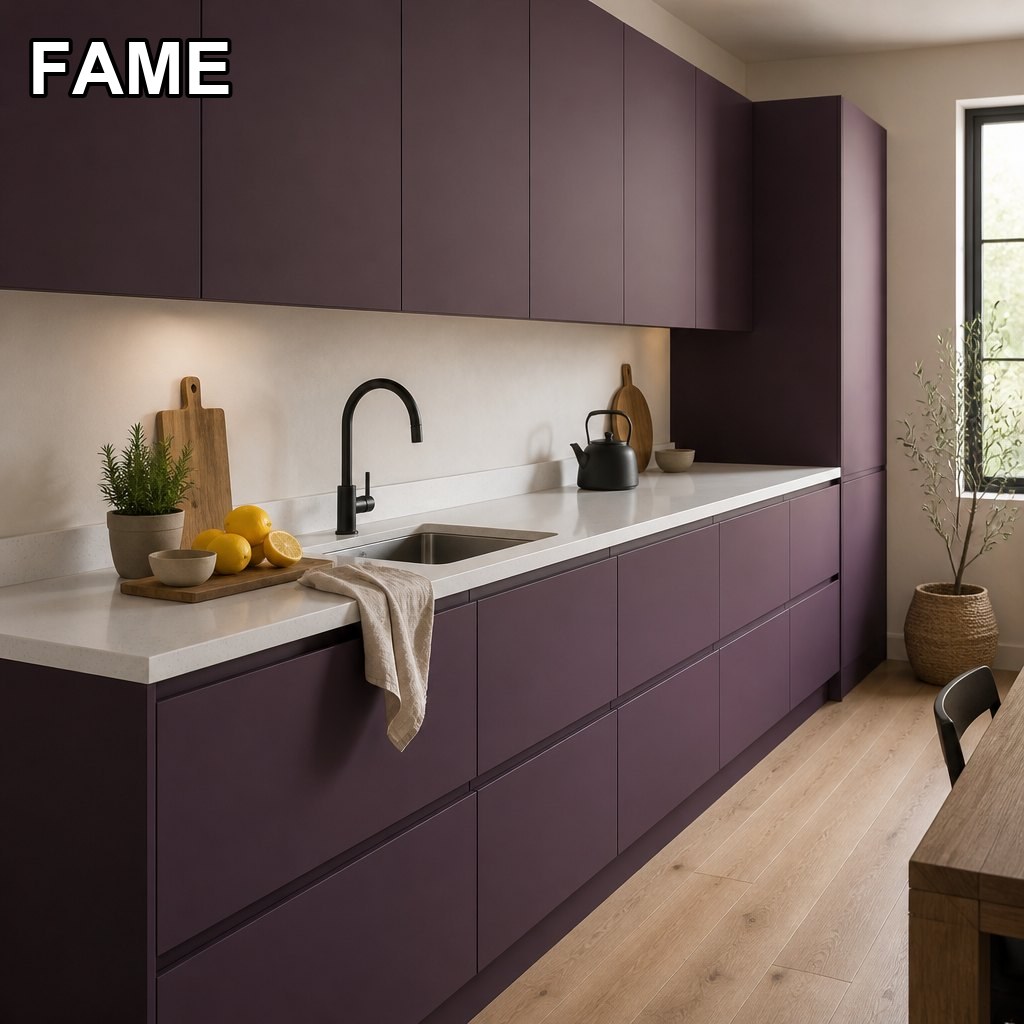
In a Real Kitchen

Aubergine Matt Lacquer Kitchen — A Plum That Reads Brown by Daylight in a real kitchen setting

Every FAME kitchen program is produced in our 20,000 m² factory, inspected against the same standards we ship to the world's top-10 bathroom brands, and container-optimized for your program.

Product FAQ

Why does aubergine look brown in one kitchen and purple in another?
Because the pigment carries both red and blue, and the balance you read is set by the colour temperature of the light rather than by the paint. Under a warm 2700K lamp the red dominates and a deep aubergine reads as a soft chocolate-plum; under a cool north window the blue comes forward and the same panel reads violet. That is not a defect and it cannot be formulated away — what can be controlled is how much black sits on top of the pigment, because black is what turns violet into an unstable purple. This programme holds the red, pulls the black back and sprays at 4 to 6 gloss units, so there is no specular highlight dragging the hue toward violet. Send us a photo of the room with the light on and we will tell you honestly whether the colour will read the way you want it to.
Is a dark matte front practical in a family kitchen?
It is practical if it is specified as a matte and not as a soft-touch. At 4 to 6 gloss units a handling mark on a deep colour is visible from close range, and no lacquer removes that: the honest answer is that a dark aubergine run needs a wipe down with a dry microfibre cloth about once a week, and a degreaser on the splashback behind the hob. What you get in exchange is a face that does not throw a reflection, that hides the fine scratches a gloss shows after two years, and that can be repaired locally — the batch code on the packing list buys a matched touch-up pot, and a scuff on a slab is a spot repair rather than a new door. What we do not recommend is this colour directly behind a gas hob without extraction, on any finish.
Why sprayed lacquer instead of a foil at this price point?
Because a deep colour is where foil shows its limits. A foil wraps an edge, so at the edge of a dark front there is either a visible band or a slight sheen change where the film turns; on a pale front nobody notices, on aubergine it reads as a line. A sprayed slab is one film over the whole face and all four edges, and it can be repaired and re-matched years later from a batch record. The trade-off is process time — a sprayed door needs primer, two colour coats and curing in a heated booth — which is why a custom colour in lacquer starts at 60 pieces while a stock foil starts at 20. For a programme already selling navy and forest green, a sprayed aubergine is the natural next colour, because the customer who buys it is the one who asked what else there is.
How does the carcass compare with the foil or veneer programmes?
It is the same carcass: 18mm E1 board, 32mm system drilling, 8mm back panel, glued and dowelled corners, soft-close hardware as standard. Only the front changes, and that matters commercially — an importer can put an aubergine lacquer kitchen, a foil kitchen and an oak veneer kitchen into one container without three sets of drawings, because the base units, the plinth, the hangers and the worktop cutting programme are common. It also means the same installer, the same fitting instructions and the same spare-parts list apply across a mixed order.
How does a 20-piece order work across widths and colours?
Twenty pieces per model, and the 20 can mix 300 to 1000mm widths, base, wall, tall and drawer units, the two handle options and the three profile finishes, because the drilling and the spray programme are the same across the range. What needs its own run is a colour change — any RAL or NCS reference in a sprayed door is 60 pieces, with a 200 x 300mm sprayed approval panel signed off first — or a non-standard worktop thickness. Production runs 20 to 35 days after finish approval, plus 28 to 35 days by sea to Hamburg or Bremerhaven. We have been building cabinets since 2009 — 17 years — in a 20,000 m² factory in Jiangshan, Zhejiang, and we supply several of the world's ten largest building-material brands on the same lines.

Quote This Kitchen Program

Tell us layout, finish and destination port — we'll come back with pricing, lead time and a sample proposal.

Request a Quote