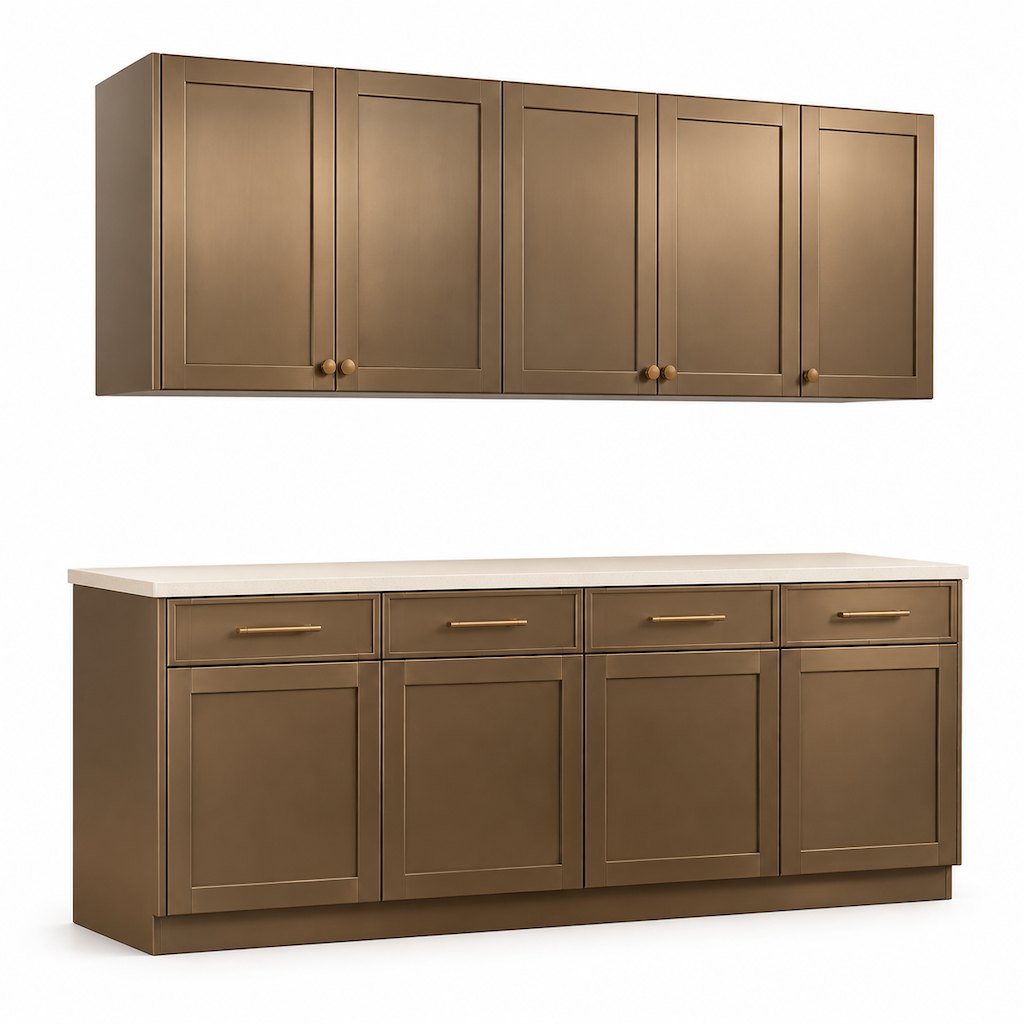
Pewter Metallic Slab Kitchen — A Cold Metallic That Still Reads Grey — FAME kitchen cabinet manufacturer
Finish Cycle II · Pewter Metallic · Matt Lacquer Slab

Pewter Metallic Slab Kitchen — A Cold Metallic That Still Reads Grey

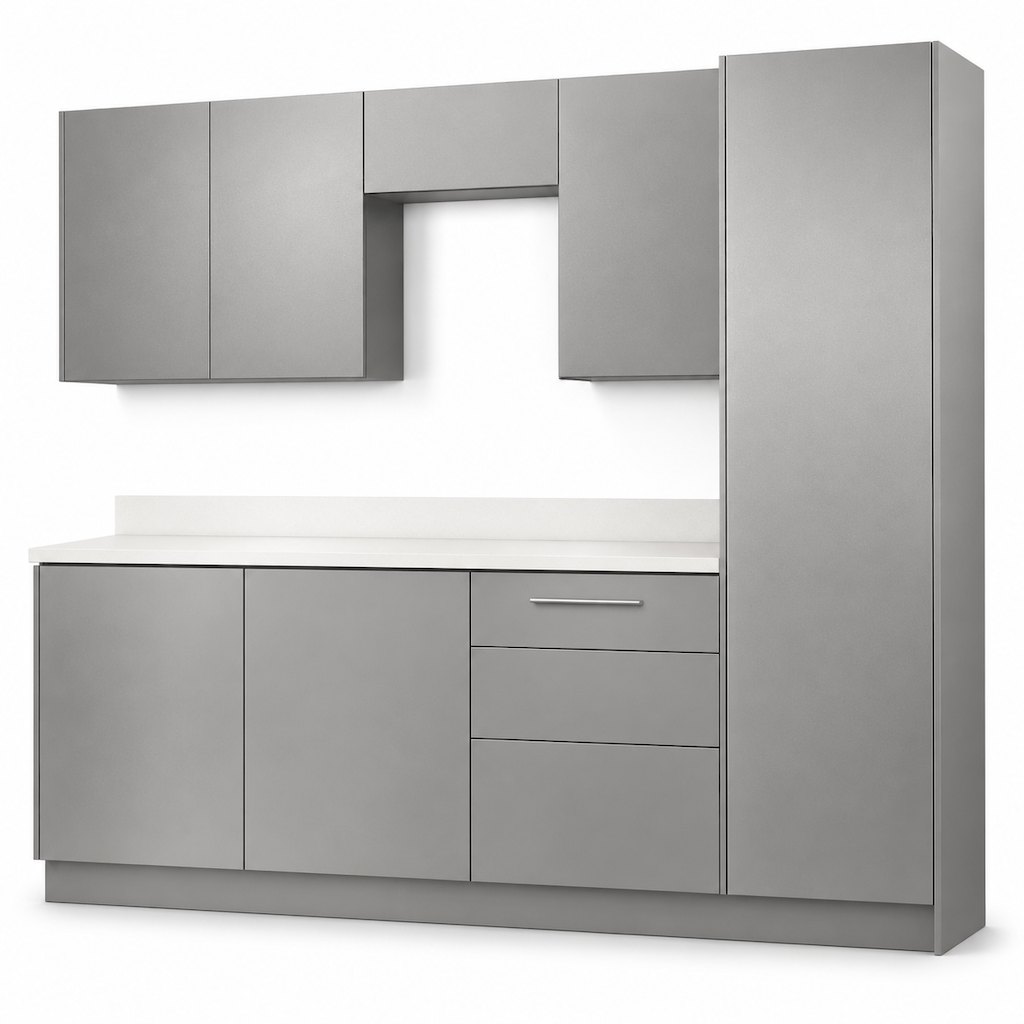
Most metallic kitchen finishes fail for the same reason: the pigment is coarse enough that a 3 m run looks like brushed aluminium, and every fingerprint near a pull becomes a visible patch. This is the opposite approach — a fine metallic pigment at low loading in a matt lacquer, so the surface reads as a cool grey with a soft directional shift rather than as metal. At roughly 8 percent sheen the fronts hold that grey under both daylight and 3000 K downlights, which is the test that decides whether a metallic stays grey or drifts warm in a showroom. The door is a single 19 mm slab with 3 mm shadow gaps set at the factory, so the elevation is one plane with no handle line: the only interruption is a slim brushed nickel pull on the one drawer stack.

  • 19 mm flat slab doors, single-piece fronts, 3 mm even shadow gaps set at the factory
  • Pewter metallic matt lacquer at about 8 percent sheen — fine pigment, cool grey base, no coarse metallic flake
  • Handleless J-profile standard along the top edge; slim brushed nickel bar pull on the drawer stack as an alternative
  • 18 mm plywood carcass with sealed edges, dovetail drawer boxes on soft-close full-extension runners
  • 20 mm white quartz worktop, slim square edge, 100 mm matching upstand; 40 mm applied edge available
  • Base, wall, tall and island units quoted as one coordinated run from a 20-piece MOQ per model

SKU: FAME-KC-PWT · MOQ: 20 pcs · Sample order available

Specifications

Program scopeBase, wall, tall and island units quoted as one coordinated run; British and European modular widths from 300 to 1000 mm on a 100 mm grid with a 3 mm door gap
Construction18 mm plywood carcass with sealed edges; E1/E0 board options; MDF carcass option on painted-only runs; 720 mm high wall units and 570 mm deep base units
Doors19 mm flat slab doors, single-piece fronts with square edges, 3 mm shadow gaps between fronts set at the factory; J-profile routed into the top edge for the handleless option
FinishPewter metallic matt lacquer at about 8 percent sheen: fine metallic pigment in a cool grey base, sprayed and sanded between coats, colour matched batch to batch across fronts, end panels and plinths; tested to 72 hours at 40 °C and 90 percent humidity without edge lift
Drawer boxesDovetail drawer boxes on soft-close full-extension runners, 40 kg rated; Blum TANDEMBOX or metal-sided option available on the same drilling
HardwareSoft-close hinges standard; handleless J-profile as the default elevation, or slim brushed nickel bar pulls at 160 mm centres set at one height across the run; Blum hinges and slides optional
Countertop20 mm white quartz with a fine speckle, slim square edge and 100 mm matching upstand; 40 mm applied edge available; supply-only option
Toe kick100 mm recessed toe kick in the same pewter metallic finish; 120 mm and 170 mm available to order; aluminium plinth option for wet zones
PackagingKD flat-pack cartons or assembled with protective cornering; metallic fronts packed face to face with foam interleaving and a film barrier, since a metallic face marks more readily than a plain matt
CertificationsISO9001, CE, SGS

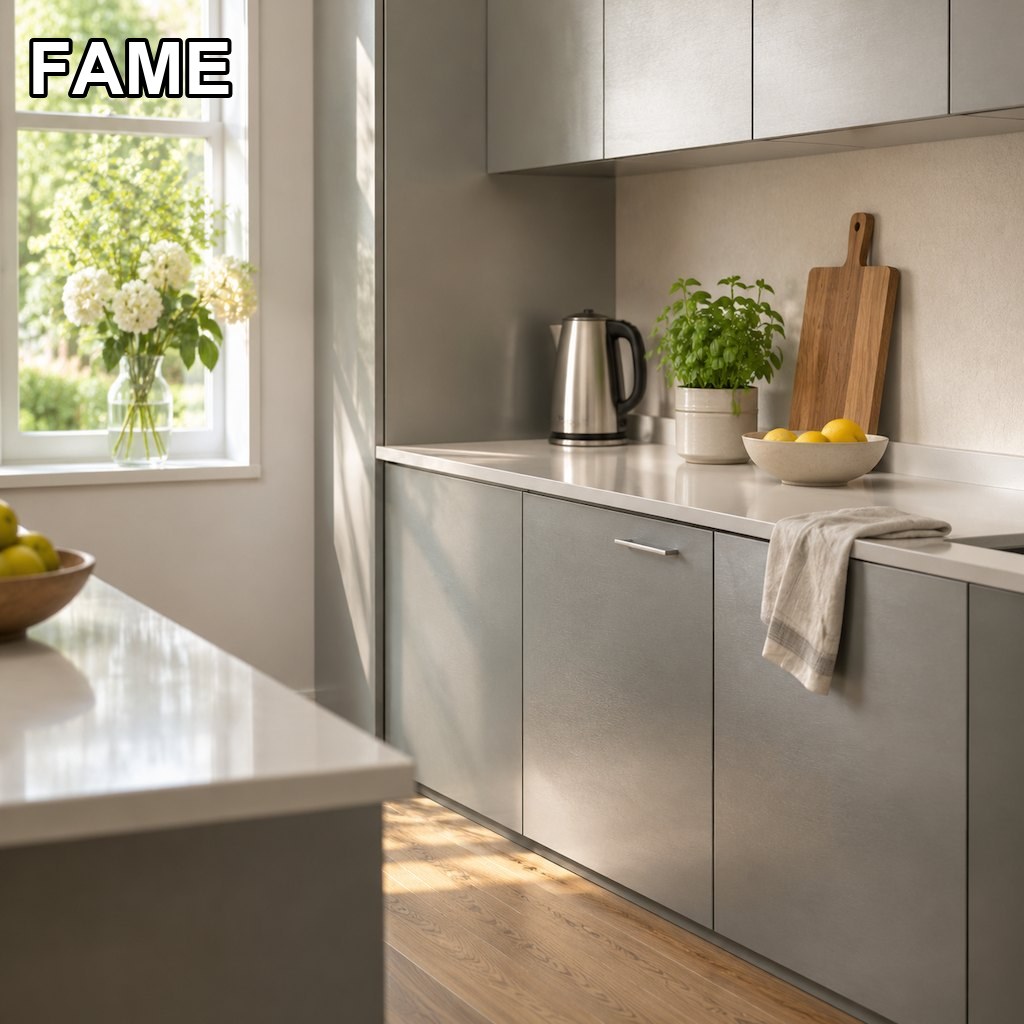
In a Real Kitchen

Pewter Metallic Slab Kitchen — A Cold Metallic That Still Reads Grey in a real kitchen setting

Every FAME kitchen program is produced in our 20,000 m² factory, inspected against the same standards we ship to the world's top-10 bathroom brands, and container-optimized for your program.

Product FAQ

What makes pewter metallic different from the bronze and champagne metallics?
Temperature and flake size. Bronze and champagne pearl sit on the warm side and are usually specified with brass or copper hardware; they read as a decorative accent and they need a room with warm light to work. Pewter is the cold version: a silver-grey base that keeps its neutrality next to stainless appliances, white quartz and oak, which is why it suits projects that want a metallic without a colour statement. The pigment loading is deliberately low — about a third of a typical metallic — so the flake does not separate visually at three metres. Above that loading a large elevation starts to look like a brushed sheet rather than a lacquered door, and any repair is impossible to blend.
Is an 8 percent metallic sheen hard to keep clean?
It is easier than a dead-matt and harder than a plain matt, and the reason is directional reflection rather than dirt. At 8 percent the reflection is scattered, so a mark on a flat door appears as a soft tonal change instead of a stain, and it wipes off with a damp cloth and neutral detergent. What it does not tolerate is abrasive cream or a silicone polish: both leave a slightly different sheen patch that shows on a metallic where it would be invisible on a flat colour. Fingerprints concentrate around the pull line, which is why the handleless J-profile option is worth considering — with no pull there is no habitual contact point, and the elevation stays even.
Why a slab door for a metallic finish?
Because a metallic shows the geometry of a door more than any flat colour does. On a shaker or a framed door, the pigment sits in a recessed panel and on four rails at slightly different angles, so the light catches each one differently and the elevation looks uneven — which reads as a defect on a metallic and as character on a painted shaker. A single 19 mm slab presents one plane, one angle and one continuous sheen. It also means the shadow gaps do the work that moulding does on a framed door: the 3 mm gap is what you see, and it has to be set at the factory rather than adjusted on site.
What carcass and top go behind this finish?
18 mm plywood with sealed edges as standard, because a metallic front reflects any carcass deflection along the 3 mm gap. E1/E0 board is available and MDF carcass is fine where the interior does not need plywood. The worktop is 20 mm white quartz with a slim square edge and a 100 mm upstand — the upstand matters at this sheen because a splash line on a metallic front is more visible than on white. Blum hinges and runners can be specified on the same drilling; for wet zones an aluminium plinth is the safer choice than a painted one.
What is the MOQ for this model?
Our MOQ is 20 pieces per model, with sample orders welcome for pre-production evaluation. Widths and handleless or pull versions can be mixed inside the 20 pieces because the carcass, 32 mm drilling and 3 mm gap are identical across the run.

Quote This Kitchen Program

Tell us layout, finish and destination port — we'll come back with pricing, lead time and a sample proposal.

Request a Quote