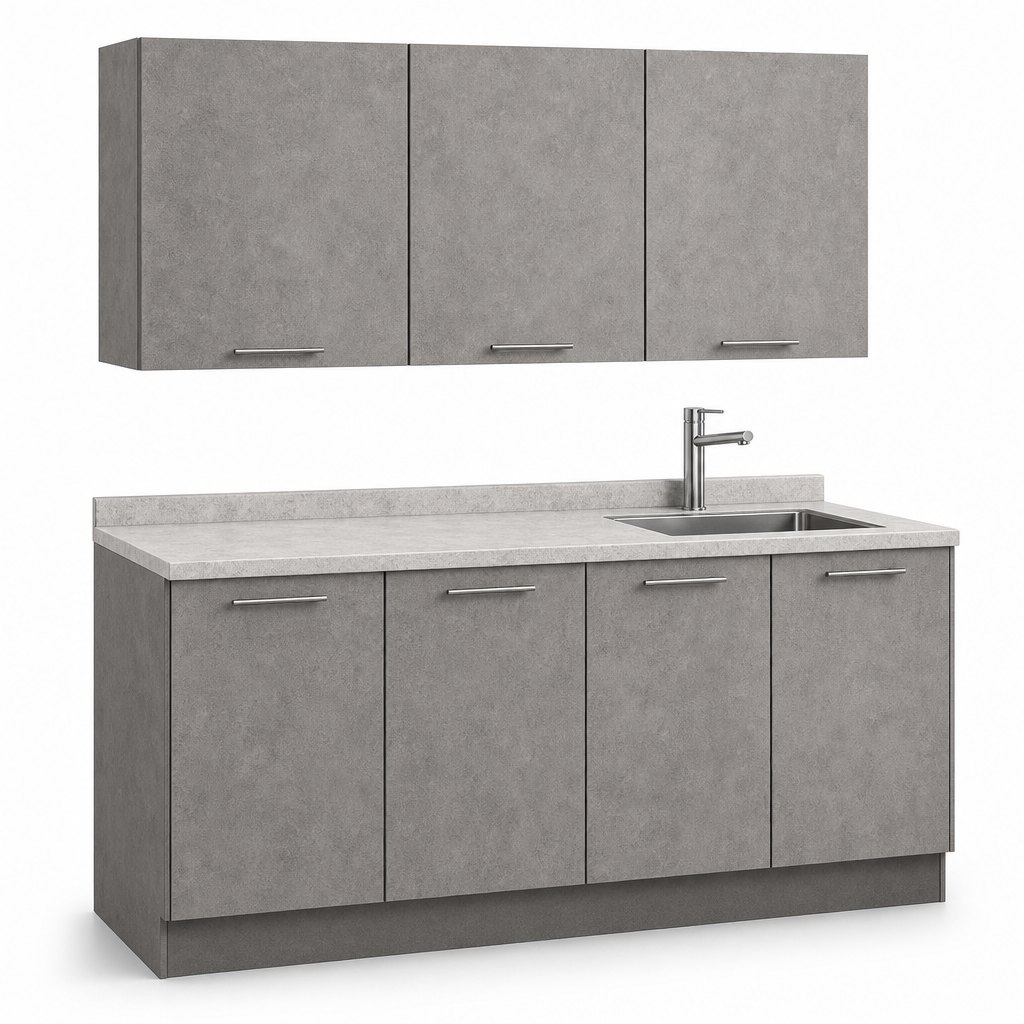
Sable Linen Kitchen — A Woven Surface Instead of Another Flat Colour — FAME kitchen cabinet manufacturer
New 2026 · Finish Cycle II · Linen Emboss · Handleless Slab

Sable Linen Kitchen — A Woven Surface Instead of Another Flat Colour

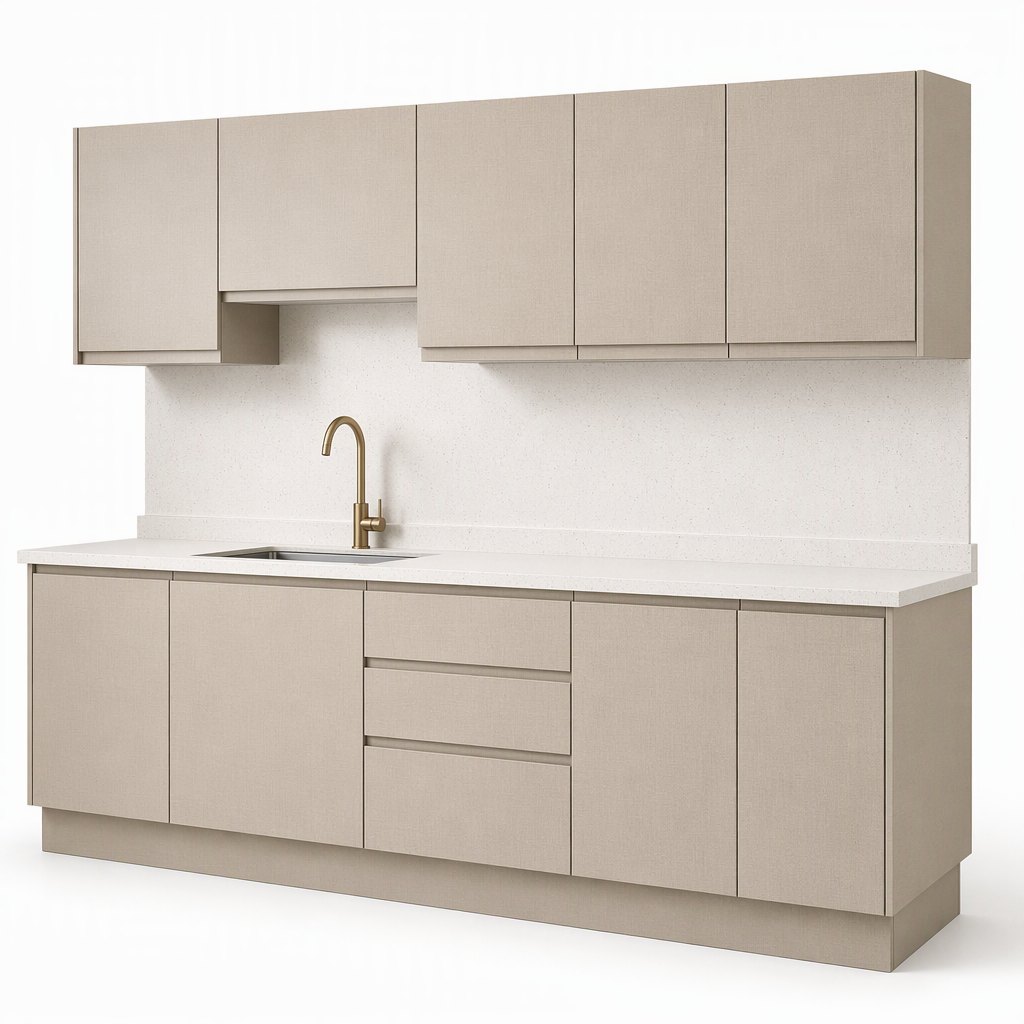
Every sand-beige kitchen looks the same in a photograph and completely different in a room, and the difference is almost never the colour — it is the surface. A flat matt panel at this tone reads as plastic under a window; the same tone with a fine woven emboss reads as cloth, holds a soft shadow along every 3mm gap, and stops showing finger marks after the second week. This programme is a sand super-matt PET with a woven-linen emboss rolled into the foil, not printed on it, laminated to a 19mm slab door with a laser edge. The texture is 0.3mm deep and directional, so it catches raking light from a window the way fabric does, and it does not repeat across a 6m run the way a digital print does. Underneath it is the standard FAME carcass: 18mm E1 board, 32mm system drilling, soft-close throughout. A second-cycle finish available across base, wall, tall and drawer units — aimed at French importers and cuisinistes selling into the beige-neutral market without wanting the fifth glossy cream kitchen on the street.

  • Sand sable super-matt PET foil with a woven-linen emboss about 0.3mm deep, rolled into the foil rather than printed, so the pattern does not repeat across a run and does not polish where hands touch it
  • 19mm flat slab doors and drawer fronts with a laser-fused edge in the same foil — no visible ABS line, no dark seam at the edge, which is the first thing to fail on a laminated door
  • Matt face at 4 to 6 gloss units measured at 60 degrees, so the surface stays non-reflective under a window and does not mirror the room the way a 10-gloss panel does
  • Anti-fingerprint top coat, tested by handling the same door face forty times and wiping once with a dry cloth — the reason a sand tone is viable at all in a family kitchen
  • 18mm E1 board carcass with sealed edges, glued and dowelled corners, 8mm back panel and 32mm system drilling on every side panel, so the run quotes and ships like a standard programme
  • Modular widths from 300 to 1000mm on a 50mm grid across base, wall, tall and drawer units, with filler panels and end panels in the same embossed foil
  • Handleless as standard: 3mm shadow gaps between fronts with an aluminium J-profile in the same sand tone, or push-open with no profile at all on the upper run
  • Soft-close hinges and soft-close full-extension runners as standard, with Blum hinges and TandemBox runners available as an option on identical drilling
  • 20mm quartz or sintered stone worktop with a 20mm upstand, cut for the sink, hob and tap to your set-out before crating, plus a matching splashback panel in the same stone
  • 100mm recessed plinth in a deeper sand tone, clip-on aluminium or matching board, set back 60mm so the base run reads as a floating mass rather than a box on the floor
  • Height-adjustable wall-unit hangers and a full set of cover caps in the matching foil, so no white plastic plug shows on a sand front after installation
  • MOQ 20 pcs per model, produced in our 20,000 m² factory, ISO9001, CE and SGS certified, 17 years in cabinet manufacturing

SKU: FAME-KC-LINN · MOQ: 20 pcs · Sample order available

Specifications

Programme scopeBase, wall, tall and drawer units as one coordinated finish programme; end panels, plinth, filler panels and cover caps in the same sand sable embossed foil
Construction18mm E1 board carcass, sealed edges, glued and dowelled corners, 8mm back panel and 32mm system drilling on every side panel; adjustable shelves on 32mm pitch; wall units on adjustable hangers
Doors and fronts19mm slab door and drawer front, 22mm on the tall and appliance-tower fronts for rigidity; laser-fused edge in the same foil; 3mm shadow-gap reveal on every joint, no frames and no visible hinges when closed
Surface and textureSand sable super-matt PET foil with a woven-linen emboss about 0.3mm deep, rolled into the foil; 4 to 6 gloss units at 60 degrees; anti-fingerprint top coat; the emboss is directional, so grain runs are marked per door on the packing list
Colour matchingSand sable is held as a stock foil; any RAL or NCS reference can be matched in a lacquered version of the same door at 60 pieces per colour, with a sprayed sample approved before the run
Modular widths300 to 1000mm on a 50mm grid; standard heights 720mm base, 720 to 900mm wall, 2010 to 2280mm tall; 560mm base depth and 350mm wall depth as standard, 600mm deep base available for appliance housings
Worktop and splashback20mm quartz or sintered stone with a 20mm upstand and a matching splashback panel; sink, hob and tap apertures machined to your set-out before crating; a 38mm laminated top is available for entry price points
Operation and handlesHandleless as standard on 3mm shadow gaps with an aluminium J-profile in the matching tone, or push-open with a magnetic touch latch on the upper run; a 160mm or 200mm bar pull is available on the same drilling
HardwareSoft-close clip-on hinges with three-way adjustment and soft-close full-extension runners as standard; Blum hinges and Blum TandemBox runners as an option on identical drilling; drawer boxes in 16mm board with a sealed base and a 25kg load rating
Plinth and finishing100mm recessed plinth, clip-on aluminium or matching board, set back 60mm; matching end panels and cornice; a 150mm plinth available for older French floors that are not level
PackagingFlat-packed in 5-layer cartons with corner protection, foam-separated door faces and a door-by-door grain-direction mark; or shipped assembled on request for contract work; one packing list per set
MOQ, lead time and compliance20 pcs per model, widths mixable inside the 20 while a custom colour or a non-standard stone needs 60 pieces; 20 to 35 days production after finish approval plus 30 to 38 days sea freight to Le Havre or Fos-sur-Mer; ISO9001, CE, SGS, IP44 and FSA certifications, E1 low-emission board and low-VOC foil

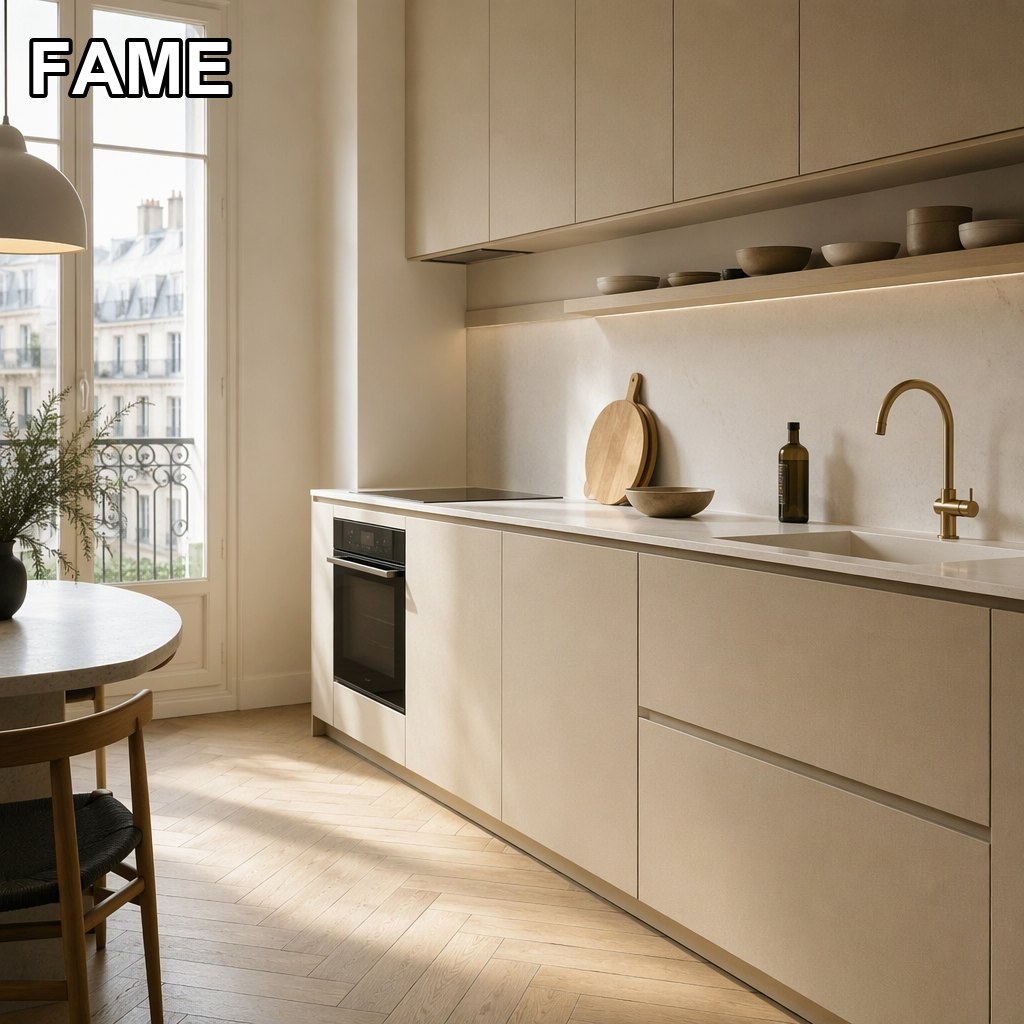
In a Real Kitchen

Sable Linen Kitchen — A Woven Surface Instead of Another Flat Colour in a real kitchen setting

Every FAME kitchen program is produced in our 20,000 m² factory, inspected against the same standards we ship to the world's top-10 bathroom brands, and container-optimized for your program.

Product FAQ

Why put an emboss on a kitchen door instead of a plain matt panel?
Because a plain matt panel in a warm neutral is the least forgiving surface in a kitchen. At 4 to 6 gloss units it shows every finger mark, and under a window it reflects as a flat sheet, which is why so many sand and greige kitchens look cheaper in a room than in the showroom photograph. A woven emboss about 0.3mm deep breaks up both: the texture scatters light instead of reflecting it, and the low points hold a fine shadow that hides handling marks between cleans. It also gives the 3mm shadow gaps something to sit against — on a flat panel the gap is just a line, on an embossed one it reads as a deliberate reveal. The emboss is rolled into the foil, not printed, so it has no repeat and no ink layer to wear through at the edge.
Does a textured face collect grease in a kitchen?
Less than a deep shaker or a beaded frame, more than a flat gloss, and the honest answer is that it needs the same wipe as any matt door. The emboss is 0.3mm — roughly the depth of a linen weave — so a cloth passes over it rather than into it, and there is no groove wide enough to trap a film of cooking fat. What we do not recommend is the darker end of this tone family in a kitchen with a gas hob and no extraction: any matt surface in a dark sand will show a grease haze at eye level after a few months. On this sand tone, with a normal 600mm extractor, a weekly dry wipe is enough; a degreaser is only needed behind the hob.
Will the laser edge really not show a line?
The edge is the same foil fused to the board edge under heat and pressure, so there is no ABS strip and therefore no colour mismatch — which is the failure everyone has seen on a laminated door, where a 2mm plastic edge reads several shades lighter than the face. The limitation is mechanical, not visual: a laser edge is slightly more vulnerable to a direct impact on the corner than a 2mm ABS band, so we ship corner protection on every door and we recommend ABS on the plinth and on any door within reach of a broom. For contract kitchens where doors take trolley knocks, we quote the ABS version in the same foil, which looks identical in a room and survives rougher handling.
Can the emboss direction be controlled across a run?
Yes, and it has to be, because the texture is directional and a door hung against the grain shows as a different shade under raking light. The grain direction is fixed per door type at the drawing stage — vertical on base and tall doors, vertical on wall doors unless the run is wider than 600mm — and every carton is marked door by door on the packing list. On site, the fitter hangs to the marks rather than to the panel, which is the difference between a run that reads as one surface and a run with two visible door shades at the end.
How does a 20-piece order work across widths and the two edge options?
Twenty pieces per model, and the 20 can mix 300 to 1000mm widths, base, wall, tall and drawer units, laser edge and ABS edge, and the two handle options, because the drilling and the foil are the same across the range. What needs its own run is a colour change — any RAL or NCS reference in a lacquered door is 60 pieces, with a sprayed sample approved first — or a non-standard worktop thickness. Production runs 20 to 35 days after finish approval, plus 30 to 38 days by sea to Le Havre or Fos-sur-Mer. We have been building cabinets since 2009 — 17 years — in a 20,000 m² factory in Jiangshan, Zhejiang, and we supply several of the world's ten largest building-material brands on the same lines.

Quote This Kitchen Program

Tell us layout, finish and destination port — we'll come back with pricing, lead time and a sample proposal.

Request a Quote