1200 mm White Oak Kitchen Display Cabinet with Reeded Glass and Shelf LED — FAME kitchen cabinet manufacturer
New 2026 · White Oak · Reeded Glass · Shelf LED

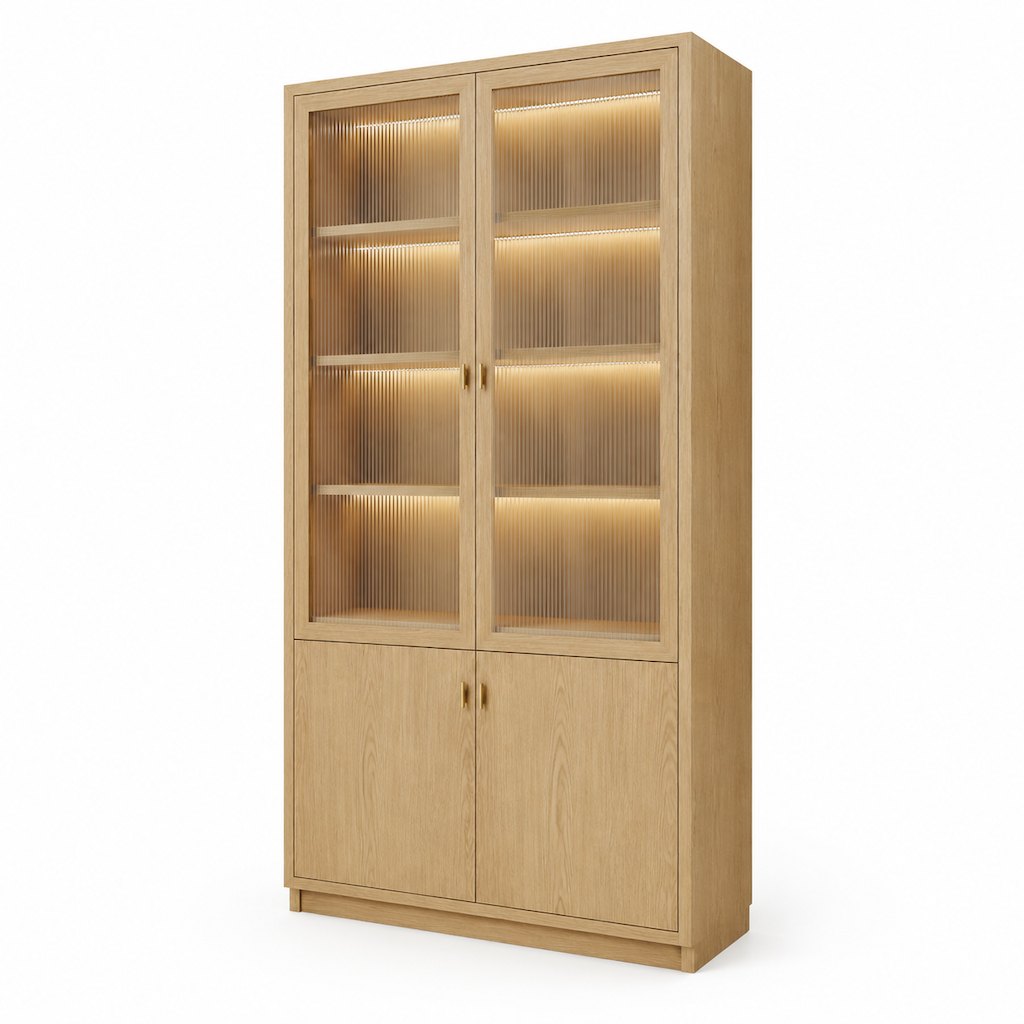
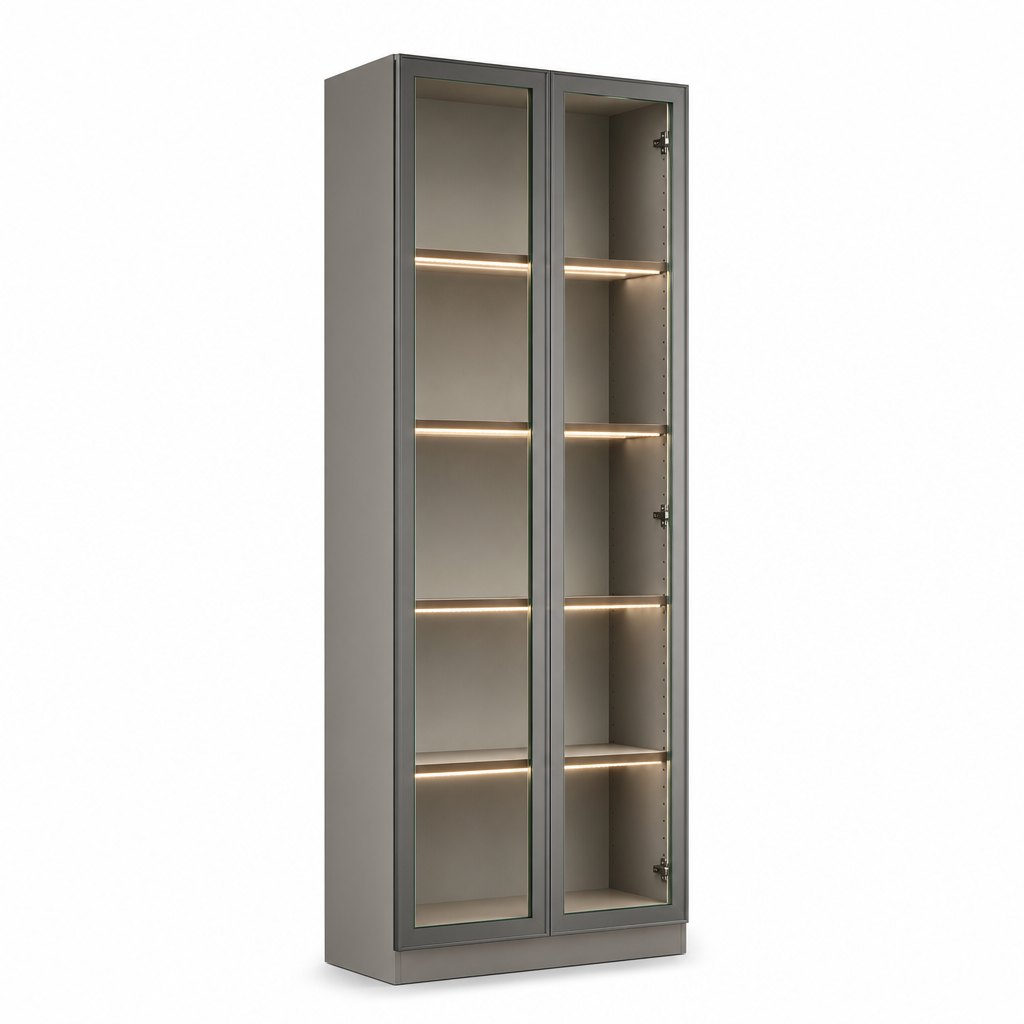
1200 mm White Oak Kitchen Display Cabinet with Reeded Glass and Shelf LED

Glass display cabinets came back into kitchen specification for a reason that has nothing to do with display: they are the only cabinet type that lets a run of closed doors stop being a wall. The problem with the clear-glass version is that it turns the kitchen into a shop window — every mismatched mug and half-empty packet is on show, and the client blames the cabinet. Reeded glass solves exactly that. The 4 mm tempered pane is rolled with vertical ribs, so the contents read as colour and shape and nothing else, while the warm LED behind it turns the cabinet into the light source for the end of the run. This is the second-generation version of the display cabinet in our kitchen programme: the first used an anthracite aluminium frame and clear glass; this one is a solid white oak frame with reeded glass, a 22 mm face frame, brass knobs, and a base cupboard below that carries the weight and hides the things that should not be seen. The frame is what makes it work in a painted or oak kitchen rather than only in a modern one, and the base is what stops a 2000 mm tall glass box from looking like a vitrine.

  • 1200 mm W x 400 mm D x 2000 mm H — upper display section 1200 x 400 x 1180 mm with two reeded-glass doors, lower base cupboard 1200 x 400 x 780 mm with two solid oak doors; 900 mm and 1500 mm widths on the same door and shelf programme
  • 4 mm reeded tempered safety glass to EN 12150, vertical ribbing at 6 mm pitch, set into a rebate in a 22 mm solid white oak face frame — the glass sits behind the frame rather than in a clip-on aluminium profile, so no exposed edge and no metal line to date the cabinet
  • Solid white oak frame and door stiles at 22 mm, with 18 mm white oak veneered panels and a 3 mm even reveal; the same cabinet is available in oak veneer throughout for a 20 to 25 percent material saving, and in ash, walnut or painted MDF on the same tooling
  • Four adjustable 18 mm white oak shelves on a 32 mm drilled system, rated 15 kg each, with a 3000K LED strip recessed into a routed channel under the front edge of every shelf so the light washes down the back of the cabinet instead of into the client's eyes
  • 8 W/m LED strip at CRI 90+ behind an opal diffuser, dimmable, with a magnetic door switch and a 24V driver in a ventilated box behind the base cupboard back panel — the low-voltage side is IP20 and the driver is serviceable without removing the cabinet
  • Lower base cupboard with two solid oak doors on Blum soft-close concealed hinges at 110 degrees with three-way adjustment, one adjustable shelf and a 60 mm recessed plinth with a continuous shadow gap
  • Solid brass knobs at 20 mm diameter with a satin lacquered finish on the display doors and base doors — matte black, brushed nickel and aged brass on the same drilling pattern, so a project can change finish without a new door run
  • Two-piece export packing on an 18 mm plywood carcass with a 8 mm back panel and a routed cable channel: display section carton 1260 x 470 x 1250 mm and base carton 1260 x 470 x 850 mm, foam corner blocks and a rigid face board in front of the glazed doors

SKU: FAME-KC-RGD · MOQ: 20 pcs · Sample order available

Specifications

Programme scopeTwo-section kitchen display cabinet — glazed upper hutch over a solid-door base cupboard — on a single oak, glass, hinge and lighting programme; supplied flat-packed or fully assembled. Widths 900 / 1200 / 1500 mm on identical doors and shelves.
Dimensions1200 mm W x 400 mm D x 2000 mm H overall; display section 1180 mm high internal, base cupboard 780 mm high; 350 mm depth available for a wall-adjacent run; 2000 mm and 2200 mm heights to order, with the glass and frame proportional to the height rather than stretched
Frame and doors22 mm solid white oak face frame, stiles and rails with a 3 mm even reveal; 18 mm white oak veneered door panels and carcass sides; reeded glass set in a 6 mm rebate from the rear and retained with a removable oak beading so a broken pane can be replaced on site
Glass4 mm reeded tempered safety glass to EN 12150, vertical ribs at 6 mm pitch, one piece per door with polished edges; clear tempered, fluted 12 mm pitch and bronze-tinted glass available on the same rebate
FinishWhite oak with a hard-wax oil or a 5 to 8 gloss unit matt lacquer; the oil finish is the one to choose if the client wants the grain to darken over five years, the lacquer if they want the colour to stay exactly as delivered; RAL-matched painted MDF on the same frame profile from 50 pcs
Carcass18 mm white oak veneered plywood with sealed ABS edges and an 8 mm back panel; 18 mm E1 MFC available as a lower-cost option where the cabinet is not in a wet zone; 32 mm system drilling throughout for shelf and hinge adjustment
Lighting and electrical3000K LED strip at 8 W/m and CRI 90+ behind an opal diffuser in a routed channel under each shelf front, dimmable, magnetic door switch, 24V driver in a ventilated service box behind the base back panel; IP20 as standard, IP44 rated strip for a cabinet within 600 mm of a hob or sink; CE and UKCA compliant driver with a 2 m mains lead and an inline connector
HardwareBlum soft-close 110 degree concealed hinges with three-way adjustment on all four doors; solid brass knobs at 20 mm diameter in satin lacquer, with matte black, brushed nickel and aged brass on the same 96 mm drilling
Internal fit-outFour adjustable 18 mm oak shelves in the display section rated 15 kg each on a 32 mm system; one adjustable shelf and one fixed shelf in the base cupboard; a glassware rack, a wine cradle and a pull-out tray available as inserts on the same drilling
InstallationTwo-part assembly — base cupboard levelled first on adjustable legs, then the display section located on dowels and fixed from inside with four connectors; wall strap supplied for anti-tip fixing; the whole cabinet can be installed by one fitter in about 90 minutes with the lighting pre-wired to a single mains tail
PackagingTwo cartons — display section 1260 x 470 x 1250 mm at 62 kg gross, base cupboard 1260 x 470 x 850 mm at 38 kg gross; 5-layer board, foam corner blocks, a rigid face board in front of the glazed doors and glass corner protectors; a 1200 mm cabinet ships at roughly 1.1 cbm
MOQ and lead time20 pcs per model, widths, heights and two finishes may be mixed inside the 20; sample door and glass panel 7 to 10 days, production 30 to 35 days, FOB Ningbo or CIF to the destination port
ComplianceISO9001, CE, SGS and FSA factory certifications; glass to EN 12150 with test certificates per batch; E1 low-emission board and low-VOC lacquer; IP44 lighting option for wet-zone installation; FSC-certified oak available on request

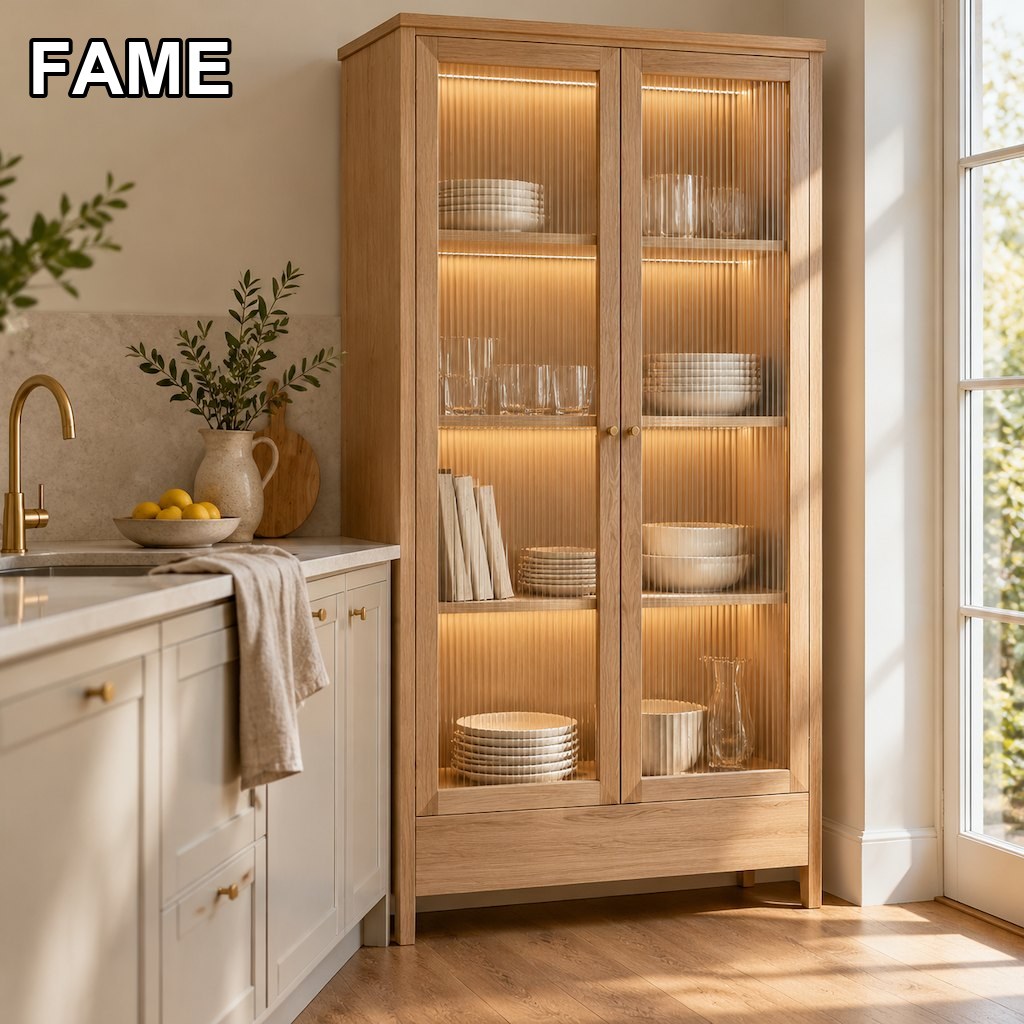
In a Real Kitchen

1200 mm White Oak Kitchen Display Cabinet with Reeded Glass and Shelf LED in a real kitchen setting

Every FAME kitchen program is produced in our 20,000 m² factory, inspected against the same standards we ship to the world's top-10 bathroom brands, and container-optimized for your program.

Product FAQ

Why reeded glass instead of clear glass in a kitchen?
Because clear glass makes the cabinet a display case the client has to keep tidy, and reeded glass makes it a light box that only has to look right. The 6 mm vertical ribbing distorts the contents enough that plates, glasses and dry goods read as shapes and colours rather than as a specific mismatched set, so the cabinet keeps working on a Tuesday evening. The cost is that reeded glass also diffuses the LED, which is an advantage: a clear pane with a strip behind it shows the individual diodes and the shelf edge, while the ribbing spreads the light into an even wash. The trade-off is optical rather than structural — behind reeded glass you cannot read a label, so a client who wants to see exactly which jar is which should have one clear section and keep the rest reeded.
How do you clean reeded glass without leaving residue in the grooves?
With a microfibre cloth and a spray bottle, working along the ribs rather than across them, then a dry pass in the same direction. The grooves are shallow and rounded, so they do not trap water like a deep fluted profile does, but a circular wiping motion will leave a haze that shows badly under the shelf LED. The detail that matters at specification stage is access: the glass sits in a rear rebate with removable oak beading, so the inner face can be released and cleaned properly twice a year instead of being reached through the door opening. In a kitchen with a gas hob, expect to do the inner face more often — airborne grease settles on the inside of any glazed door within a metre of the cooking zone.
Does the LED strip survive steam from a kettle or a hob nearby?
The standard strip is IP20 and it is fine inside a closed cabinet, because the cabinet is a dry enclosure and the strip is behind a diffuser. It is not fine in the 600 mm zone beside a hob or a sink, where steam and spatter reach it, and for that position we specify the IP44 rated strip and a sealed driver box at the same price band. Heat is the other consideration: an 8 W/m strip in a 1180 mm cavity adds roughly 10 W of heat, which is nothing for the glass but will shorten the life of a driver buried in an unventilated void, which is why the driver sits in a ventilated service box behind the base back panel rather than in the display section. The strip itself is rated 25,000 hours at 70 percent lumen maintenance, and it is a magnetic click-fit so a failed section is a two-minute replacement without touching the wiring.
Is 1200 mm too wide for a glass cabinet, and can it be narrower?
1200 mm is the width at which two doors still open without a centre mullion and the shelves stay stiff enough not to sag under glassware; beyond that the door weight and the pane size start to drive the price. The same doors, glass, shelves and lighting run at 900 mm and at 1500 mm as a three-door version, so a project can size to the wall without a new design. What changes with width is the ratio: at 900 mm the cabinet reads as a tall cupboard, at 1500 mm it reads as a dresser and needs a longer base to carry it. Where the ceiling is low, the 2000 mm height is usually the constraint rather than the width, and we build to 1900 mm with the same proportional door split rather than squeezing the glass.
How is a glazed cabinet packed for export, and what does a 20-piece order look like?
It ships in two cartons because a 62 kg glazed upper section and a 38 kg base should not be stacked as one unit, and because a two-part cabinet is far easier to carry up a European stair than a 2000 mm assembled box. The glazed doors travel with a rigid face board and corner protectors in front of them, and the glass is retained by beading rather than by silicone, so a pane that does break in transit is replaceable without a new door. Twenty pieces can be split across 900, 1200 and 1500 mm widths, two heights and two finishes, with a RAL-matched painted version starting at 50 pcs; a mixed 20-piece order lands at roughly 22 cbm, which is close to a 20 ft container on its own. Sample lead time is 7 to 10 days, production 30 to 35 days, FOB Ningbo or CIF.

Quote This Kitchen Program

Tell us layout, finish and destination port — we'll come back with pricing, lead time and a sample proposal.

Request a Quote